Cinemas, Multiplexes, and Entertainment Venues: The Signage Report
India has more cinema-goers than almost any country on earth and fewer screens per person than almost any major market. The industry’s biggest constraint is not audience. It is access. And inside the screens that do exist, the display technology is changing faster than at any point since digital projection.
Welcome back to Beyond the Screen. This edition we step into India’s cinemas, multiplexes, and entertainment venues, where the display is not supporting the business. The display is the product.
🔲 The big picture: an under-screened market that is premiumising
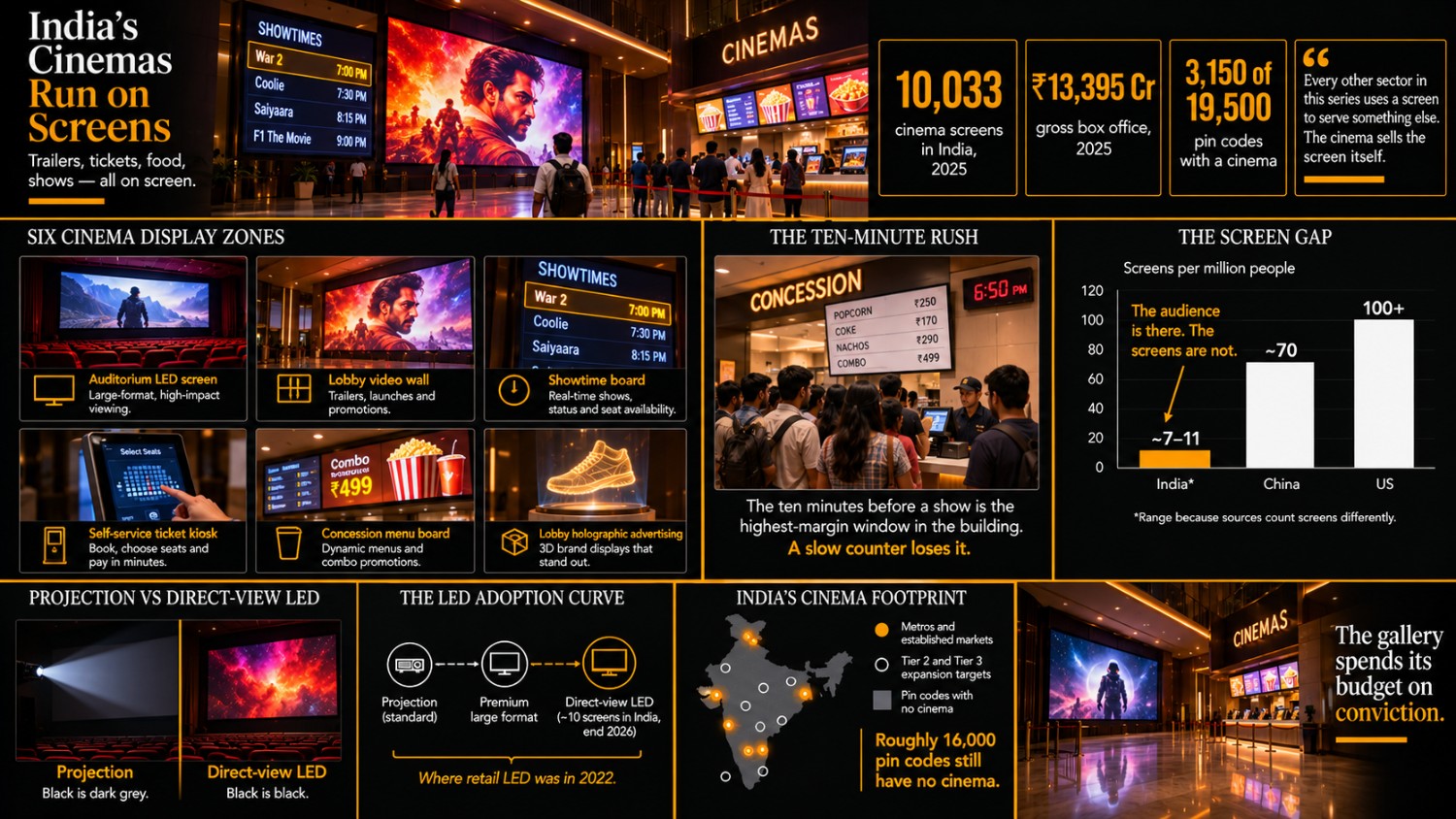
India had roughly 10,033 cinema screens in 2025, adding about 240 while around 124 mostly single screens shut, a net rise of about 1%. By one count that is 6.8 screens per million people. The country’s largest operator puts it at 10 to 11 per million. Either way it sits against more than 100 in the US and around 70 in China. Only about 3,150 of India’s roughly 19,500 pin codes have a cinema at all.
Gross box office reached ₹13,395 crore in 2025, with the national average ticket price at ₹161, up 20% year-on-year.
The largest operator now runs 1,797 screens across 358 properties in 114 cities, holding roughly 43% of India’s multiplex screens and over half of multiplex box office revenue. Its network is 48% metros, 30% Tier 1, and 22% Tier 2 and Tier 3, and it is shifting toward smaller cities, including budget “smart cinema” halls with ticket prices under ₹175.
Premium formats made up about 15% of that operator’s screens in 2024, with a stated target of 20%. Higher-end formats allow higher ticket prices and lift food and beverage revenue, which is why chains are prioritising them even as they widen reach.
By the numbers:
→ 10,033 — India’s cinema screens in 2025, with net growth of about 1%
→ ₹13,395 crore — gross box office in 2025
→ 22% — share of the largest operator’s screens now in Tier 2 and Tier 3 cities
🔲 What display technology is doing across the cinema venue
A cinema is a sequence of screens. The one in the auditorium gets the attention. The rest of the building is where the display work is quietly happening.
Direct-view LED in the auditorium
The most significant shift in cinema display in years is the arrival of direct-view LED screens replacing the projector and the white screen. Unlike projection, LED is self-emissive, so black is truly black, brightness is higher, and the picture does not depend on the room being dark. India is early in this. By the end of 2026 the country is expected to have around ten cinema LED screens. That includes a 14-metre 4K direct-view installation paired with immersive sound in Kochi, and an acoustically transparent LED screen unveiled at a Chennai exhibition. The count is small. The direction is clear, and it is the same fine-pitch LED trajectory covered in Edition 03.
Lobby video walls and showtime boards
The ticket counter queue and the printed showtime board are being replaced by lobby LED walls running trailers, showtimes, and now-showing content, managed from a central CMS (as covered in Edition 20). A film release or a ticket price change goes live across every screen in every property in minutes.
Self-service ticketing and kiosks
Self-service kiosks at the cinema lobby remove the queue for walk-in customers. For families arriving with children and wanting to buy tickets and snacks together, a kiosk that handles both in one transaction is faster than two separate counters.
Concession menu boards
Concessions are where cinemas earn much of their margin, and the menu board is the sales surface. As covered in Edition 04, a digital menu board can switch between combo promotions by show time, feature the high-margin items first, and remove sold-out items automatically. For a cinema where a rush of customers arrives in the ten minutes before every show, queue speed at the concession counter is a direct revenue variable.
Immersive and holographic lobby advertising
Cinema lobbies are high-dwell, high-footfall environments with an audience that is already in a consumption mood. Holographic and 3D advertising formats have begun appearing in cinema lobbies in Delhi and Mumbai, with a wider rollout across around 50 cinemas planned. For brands, the lobby is premium out-of-home inventory with a very good audience.
Entertainment zones and wayfinding in malls
Cinemas rarely stand alone. They sit inside malls, next to family entertainment zones, gaming arcades, and food courts. Wayfinding displays and zone-level digital signage connect those experiences and move visitors between them.
🔲 The India-specific angle: the screen gap, the franchise model, and the mall
The screen gap is the growth story
India’s cinema opportunity is geographic. Most of the country has no multiplex. Closing even part of that gap means thousands of new screens, and each new screen needs a lobby, a ticketing point, a concession counter, and display infrastructure built to the same standard as a metro property. The operator’s shift toward smaller cities is a display deployment pipeline as much as a real estate one.
Franchise-owned, company-operated expansion
The largest operator is moving to a model where partners fund construction and the operator runs the cinema, paying a royalty of about 8–10% of revenue. This lets chains open in underserved markets while keeping control of the experience. That control is partly a display question: a franchised property in a Tier 3 town still has to look and operate like the flagship, which makes standardised, centrally managed display infrastructure the practical way to deliver it.
The mall is changing what it wants from the cinema
A cinema has long been a mall’s anchor tenant. But multiplex share of mall footfall has reportedly slipped from around 10% to 6–7%, and developers are shifting space toward food and beverage and family entertainment zones that deliver steadier traffic. For cinema operators, this raises the stakes on experience. The cinema has to give a reason to come, and the lobby has to turn that visit into spend.
Premium and affordable, at once
India’s cinema market is splitting into two tiers: premium large-format screens for the metro audience, and low-priced smart cinemas for price-sensitive markets. The display requirement differs by tier but both need it: a premium lobby is a brand environment, while a budget cinema needs fast, low-cost, low-staff operations, which is where kiosks and digital menu boards earn their keep.
🔲 Three signals worth tracking
1. LED is the premium upgrade to watch
Ten LED cinema screens is a small number in a country of ten thousand. But the pace of announcements suggests LED is moving from novelty to a standard premium option. If it follows the path of LED in retail and enterprise, price will fall and installs will spread from flagships to Tier 2 cities within a few years.
2. The concession counter is the next kiosk frontier
Cinemas have the ideal kiosk conditions: a predictable rush, a high-margin product, and customers who want to be back in their seat before the film starts. Self-order for food and beverage, with pickup at a counter, is the most commercially direct display deployment in the building.
3. The lobby is becoming a media network
Cinema chains already sell on-screen advertising. The lobby is the same audience at a different moment, and digital lobby inventory sold programmatically, with the retail-media logic from Edition 13, is a natural extension. The operators who build a connected lobby display network can add a revenue line that costs very little to run.
🔲 Closing thought
Every other sector in this series uses a screen to serve something else: a sale, a patient, a student, a shift. The cinema sells the screen itself.
That makes it the one deployment where display quality is the product. A better picture, a larger frame, a blacker black are things a customer pays more for, and the industry is repricing around them.
India’s cinema industry has the audience. It is still building the screens. The operators who build them well, from the auditorium to the lobby to the concession counter, will define how India watches films for the next decade.
Until next time — stay switched on.
Beyond the Screen is published by Techworks — digital display and kiosk solutions for India’s retail and hospitality sector.
techworksworld.com · contact@techworksworld.com