Real Estate & Property Sales — Site Offices, Experience Centres
A buyer is being asked to commit ₹1.5 crore to a building that does not exist yet.
The sales gallery has one job: make the unbuilt feel real.
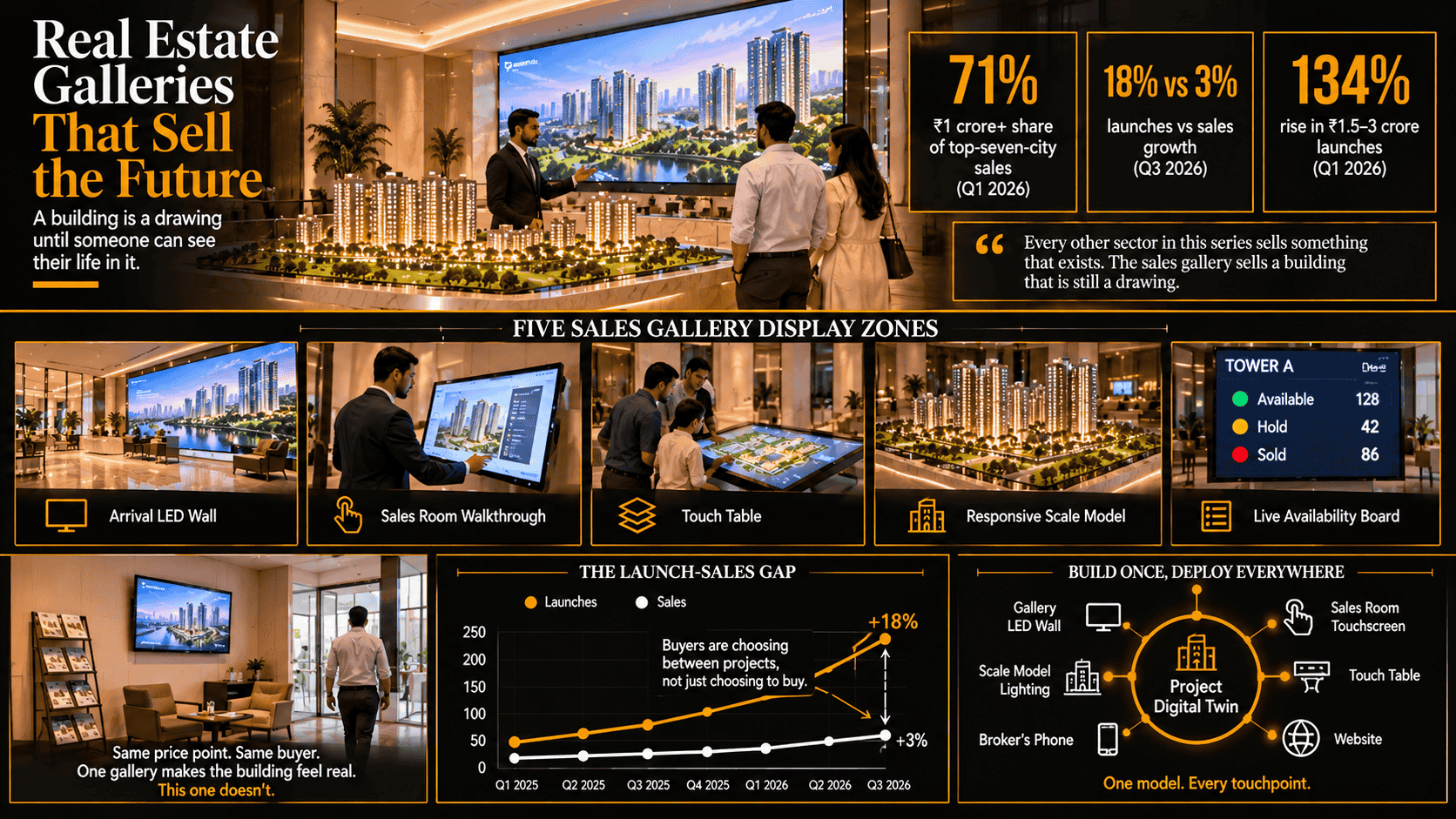
In Q1 2026, 71% of residential sales in India’s top seven cities were homes priced at ₹1 crore and above, up from 59% a year earlier. But supply is moving faster than demand. In Q3, launches grew 18% year-on-year while sales grew 3%. Buyers are no longer deciding whether to buy. They are choosing between projects.
That changes what the gallery has to do. A scale model, a brochure rack, and a video loop nobody watches no longer match the price of what is being sold.
The galleries converting best are built around the buyer’s journey. An LED wall in reception that sets the tone while the buyer waits. A sales room where the executive takes a family from master plan to tower, floor, and unit view in real time rendering. A touch table where the whole family explores availability together. A scale model that lights up in sync with the film. A live inventory board that shows which units are still open.
In a market where a home purchase is a family decision made before construction begins, the display layer is where credibility is built or lost.
Welcome to Beyond the Screen. This edition we step into India’s real estate sector, specifically the sales gallery and experience centre, where a developer converts a master plan, a render, and a promise into a signed booking.
🔲 The big picture: more homes are being launched than sold
India’s residential market is premiumising fast. JLL recorded 90,023 launches across the top seven cities in Q1 2026, up 13% year-on-year, against 70,631 units sold, up 8%. Homes priced at ₹1 crore and above made up 71% of sales, up from 59% a year earlier. Launches in the ₹1.5–3 crore band rose 134%.
But supply is moving faster than demand. ANAROCK’s Q3 2026 figures show roughly 1,14,320 launches against 1,00,220 sales across the top seven markets, with launches up 18% year-on-year and sales up only 3%. In Q2 it was about 1,06,000 launches against 90,700 sales.
For a developer, that gap changes the job of the sales gallery. When inventory is abundant and tickets are high, the buyer compares projects and takes their time. As one developer put it, buyers are placing far greater emphasis on execution, delivery, and developer credibility. The gallery is where that credibility is either demonstrated or not.
By the numbers:
→ 71% — share of top-seven-city residential sales priced at ₹1 crore and above in Q1 2026, up from 59%
→ 18% vs 3% — year-on-year growth in launches vs sales in Q3 2026
→ ₹1,000 crore — size of a single 1,000-residence premium launch in North Bengaluru in June 2026
🔲 What display technology is doing inside the sales gallery
The traditional gallery had three things: a scale model, a brochure rack, and a looping video that nobody watched past the first minute. The modern one is built around the buyer’s journey, and screens sit at every stage of it.
The arrival wall
A large LED wall in the reception or waiting area does what the scale model used to do alone: set the tone before a single word is spoken. A buyer who is waiting for an available sales executive is a captive audience. Project highlights, amenity films, and construction progress on a wall in that space keep them engaged and warm the conversation that follows.
The meeting room walkthrough
This is where the sale happens. Leading developers now equip dedicated sales rooms with large touchscreens running real-time 4K rendering, controlled by the sales executive from a tablet. One Mumbai residential project outfitted five meeting rooms this way, with an LED wall in the waiting area linked to the same content. The executive can take a buyer from the master plan to a specific tower, floor, and unit, then show the view from that unit, without leaving the screen.
The touch table
Master plans, floor plates, and unit availability explored by hand at table height, with the whole family around it rather than one person holding a brochure. In India, where a home purchase is a family decision, this format fits how the decision is actually made.
The responsive scale model
Physical models are not going away. They are getting connected. LED lighting inside the model can respond to the screen: as a film introduces the clubhouse, the clubhouse lights up on the model. As the masterplan animation moves through phases, the model follows. For a luxury project, the physical model carries the craftsmanship and the screen carries the intelligence.
Live availability displays
A sales board that shows which units are available, held, or sold, updated in real time from the sales CRM, removes the awkward pause where an executive has to check whether a unit is still open. It also creates honest urgency. A buyer who watches a tower’s inventory change during their visit makes a different decision from one reading a static price list.
Handover and community signage
The display story does not end at the sale. After handover, the same developer installs lobby notice boards, society communications, and visitor management in the building. A developer that specifies a display platform in the sales gallery can extend it across the community, turning a marketing cost into a long-term infrastructure relationship.
🔲 The India-specific angle: the family decision, the off-plan sale, and the premium buyer
The off-plan problem is bigger in India than most markets
A large share of Indian residential sales are made before construction is complete. The buyer cannot walk through the product. That puts unusual weight on whatever the gallery shows them, and digital walkthroughs, virtual unit tours, and real-time rendering are the mechanism that makes an unbuilt home feel credible. Photography-based tours need a finished property. A digital twin built from architectural drawings does not.
Premiumisation raises the standard of the room
When 71% of sales are above ₹1 crore, the buyer walking into the gallery has seen premium environments elsewhere: hotels, luxury showrooms, flagship retail. As covered in Editions 05 and 16, those spaces have set an expectation for what a premium environment looks like. A gallery with a dated TV and a printed brochure stand does not match the price point of what it is selling.
The cost of a gallery makes display a rounding error
Globally, a decorated model unit is benchmarked at $90,000 to $360,000 or more, and a physical scale model at $9,000 to well over $700,000. Against those costs, and against a sales cycle where one booking is worth over a crore, the display layer is a small and visible share of the total budget. The question for a developer is less about cost and more about whether the gallery looks like it belongs to the project being sold.
Tier 2 and integrated townships are the next build wave
Developers are moving into integrated townships and mixed-use projects at scale, and into cities beyond the top seven. Each new launch, in each new market, needs a sales gallery. Many of these will be temporary or semi-permanent structures where modular, relocatable LED and touch infrastructure is a better fit than permanent installation.
🔲 Three signals worth tracking
1. The sales gallery is becoming a data source
A touch table or sales-room screen that logs which towers, floors, and amenities buyers explore generates demand intelligence the sales team has never had. If buyers keep opening east-facing units on higher floors, that tells the developer what to release next and how to price it. The display becomes a research instrument.
2. Digital twins are replacing static renders
One digital twin built from the architectural drawings can drive the gallery wall, the sales-room tablet, the website, and the broker’s phone. For developers launching multiple projects a year, the economics of building once and deploying everywhere are compelling, and the LED wall is where that content reaches its most cinematic form.
3. The launch-sales gap will reward the best-presented projects
With launches running ahead of sales, buyers are choosing between projects, not just choosing whether to buy. In that environment, the quality of the buyer’s first hour in the gallery is a measurable competitive variable. Developers who treat it as one will convert more of the same footfall.
🔲 Closing thought
Every other sector in this series sells something that exists. The QSR sells a burger. The showroom sells a car on the floor. The real estate gallery sells a building that is still a drawing, to a buyer who will pay for it over twenty years.
That is the hardest job any display in this series has been given. It has to make the future tangible, build trust in a developer, and give a family enough confidence to sign.
The gallery that does that well has not spent money on screens. It has spent it on conviction.
Until next time — stay switched on.
Beyond the Screen is published by Techworks — digital display and kiosk solutions for India’s retail and hospitality sector.
techworksworld.com · contact@techworksworld.com