Healthcare and Clinics: The Digital Signage Report
Beyond the Screen Edition 28 · 17 November 2026
India now has more than 93 crore digital health IDs. Most of those patients still walk into an OPD, take a paper slip, and wait for a name or number they may never hear called. The health records are digital, but the hospital corridor still runs on paper. That gap is where this edition sits.
Welcome back to Beyond the Screen. After banking last week, we turn to a building where waiting costs more than time: the hospital. Healthcare in India is scaling fast on two tracks at once. One is the digital backbone the state is building. The other is physical capacity, as private chains add beds and specialty clinics open in cities that didn’t have them five years ago. Displays and kiosks sit right between those two tracks. They’re where a digital system finally reaches a patient standing in a lobby.
🔲 The big picture
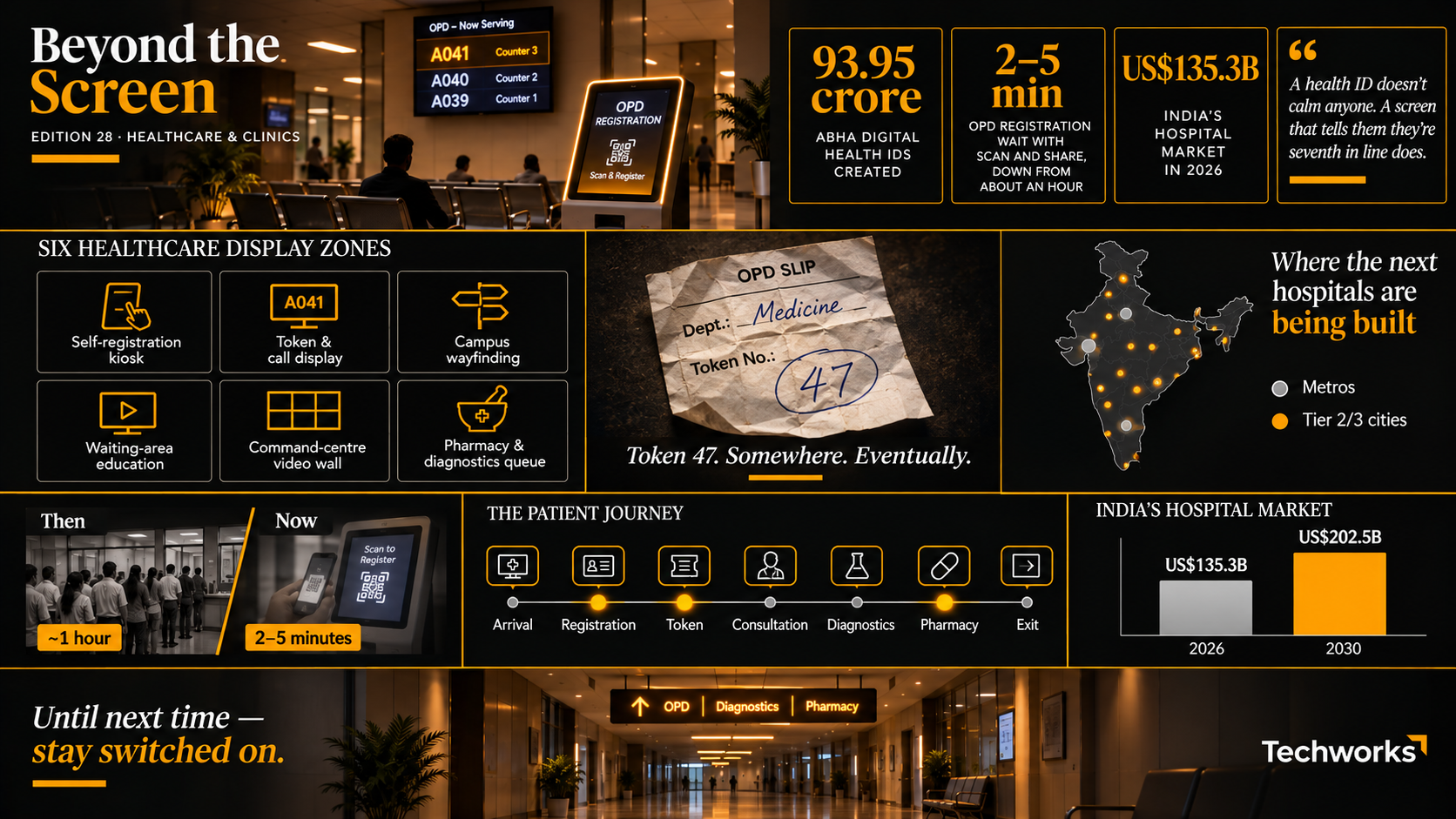
The policy layer has moved faster than most hospitals have. The Ayushman Bharat Digital Mission has built one of the largest digital health ecosystems in the world, with more than 93.95 crore ABHA IDs created and over 104 crore health records linked to them. The Scan and Share OPD service, where a patient scans a QR code instead of filling a registration form, has crossed 25 crore OPD registrations. Official figures put the effect on waiting time at about an hour cut to 2–5 minutes.
Public coverage is also bringing more patients into formal care. By June 2026, Ayushman Bharat PM-JAY had supported 12.69 crore hospital admissions, with treatment worth about ₹1.92 lakh crore. A large share of those admissions happen in private hospitals, so scheme patients are now a core part of the private operator’s daily flow.
Capacity is following. India’s hospital market is estimated at US$135.3 billion in 2026 and projected to reach US$202.5 billion by 2030. Brokerage estimates put healthcare delivery on track for about ₹12 trillion by FY30, growing 10–12% a year, with private providers expected to deliver around 69% of treatments. Large private chains still hold only about a fifth of the hospital market, so most of the system is mid-sized hospitals, nursing homes and clinics that are digitising now.
The weak point is adoption at the front desk. Research on ABDM keeps finding the same two problems: everyday ABHA usage lags far behind enrolment, and legacy hospital management systems don’t easily talk to the national stack. The ID exists. The physical moment where a patient uses it often doesn’t.
By the numbers: → 93.95 crore ABHA IDs, with 104 crore+ health records linked → 25 crore OPD registrations through Scan and Share, with waits cut from about an hour to 2–5 minutes → US$135.3 billion hospital market in 2026, projected to reach US$202.5 billion by 2030
🔲 What display technology is doing in healthcare
- Self-registration kiosks at the OPD door The first queue in any Indian hospital is the registration counter. Kiosks that accept an ABHA QR scan, print a token and route the patient to the right department move that queue to the lobby. Scan and Share already proves the time saving on a phone. A kiosk brings the same saving to patients who don’t have a smartphone, or who are too unwell, too old or too anxious to use one.
- Token and call displays by department A paper slip says nothing about where you stand. Department-level displays show tokens being called, how many are ahead, and which room to go to, so the waiting area stops being a crowd around one door. For hospitals with high scheme volumes, this is the cheapest way to make a crowded OPD feel orderly.
- Wayfinding across sprawling campuses Tertiary hospitals are built in blocks, wings and floors added over decades. Interactive directories and digital signs at each junction cut the “where is radiology?” question that front-desk staff answer hundreds of times a day. They can also be updated in minutes when a department moves, which painted signs can’t.
- Patient education in waiting areas Waiting time is the one block of attention a hospital gets for free. Screens in OPD and diagnostic waiting areas can carry vaccination schedules, pre-procedure instructions, scheme eligibility and ABHA enrolment prompts. Done well, this content helps the patient. Done badly, it’s pharma advertising on a loop, and patients learn to ignore it.
- Command-centre video walls Larger networks are running bed management, emergency inflow, ambulance tracking and equipment status from a central room. A video wall turns that data into a shared picture the operations team can act on together, which matters most when emergency inflow spikes.
- Pharmacy and diagnostics queues After consultation, patients queue again for the pharmacy, sample collection and reports. Display-driven queueing at these counters, along with “report ready” screens, removes the second wave of crowding that most hospitals forget to design for.
🔲 The India-specific angle
ABDM makes the kiosk a policy touchpoint Hospitals are expected to support ABHA creation and linking, consent-based data sharing and digital claims. Each of those needs a physical place where the patient takes part. A registration kiosk or a counter-facing screen is often that place. Treating displays as part of ABDM readiness rather than as “signage spend” changes how the budget conversation goes.
DPDP changes what can appear on a screen Health data is personal data under the Digital Personal Data Protection Act. Calling “Ramesh Kumar, Room 4” on a public display is a habit that now carries risk. Token-only calling, masked names, and screens placed so they can’t be read from the corridor should be the default.
Language is a clinical issue, not a courtesy A misread instruction before a procedure or a missed token call has real consequences. Regional-language content, icon-led wayfinding and audio announcements alongside visual ones are basic requirements in a country where patients regularly travel across state lines for treatment.
Tier 2 and 3 is where the build-out is happening The Union Budget 2026-27 proposed five regional medical hubs, and single-specialty chains in eye care, dialysis, IVF, oncology and orthopaedics are expanding fast outside the metros. These are new buildings, so displays can be planned into the design from the start rather than retrofitted. Specialty formats also repeat well: once a clinic layout works, it can be copied to every new site.
🔲 Three signals worth tracking
- From enrolment to usage ABDM’s next phase is explicitly about using the records, not just creating IDs. Every policy push in that direction increases the value of a point-of-care screen where patients actually scan, consent and share.
- Paperless claims reaching the front desk The National Health Claims Exchange is moving insurance claims onto digital rails. As claims get faster, the bottleneck shifts to admission and discharge desks, which are the next places that need clear status displays.
- Specialty chains standardising their spaces Single-specialty formats are growing faster than the hospital market overall. Chains that open dozens of near-identical clinics will want centrally managed screens they can update across sites in one push. That’s a CMS problem as much as a hardware one.
🔲 Closing thought
India has built the national digital layer for healthcare at a scale few countries have tried. What it hasn’t built yet is the last few metres: the lobby, the corridor and the waiting bench where a patient either feels guided or lost. A health ID doesn’t calm anyone. A screen that tells them they’re seventh in line and Room 12 is on the left does.
At Techworks, we’ve spent 19+ years putting 50,000+ screens to work across 13+ industries. In healthcare, the brief is simple: less crowding at the counter, clearer direction in the corridor, and nothing on a public screen that a patient wouldn’t want strangers to see.
Until next time — stay switched on.
Beyond the Screen is published by Techworks — digital display and kiosk solutions for India’s retail and hospitality sector. www.techworks.co.in