Banking and Financial Services Branch Experience
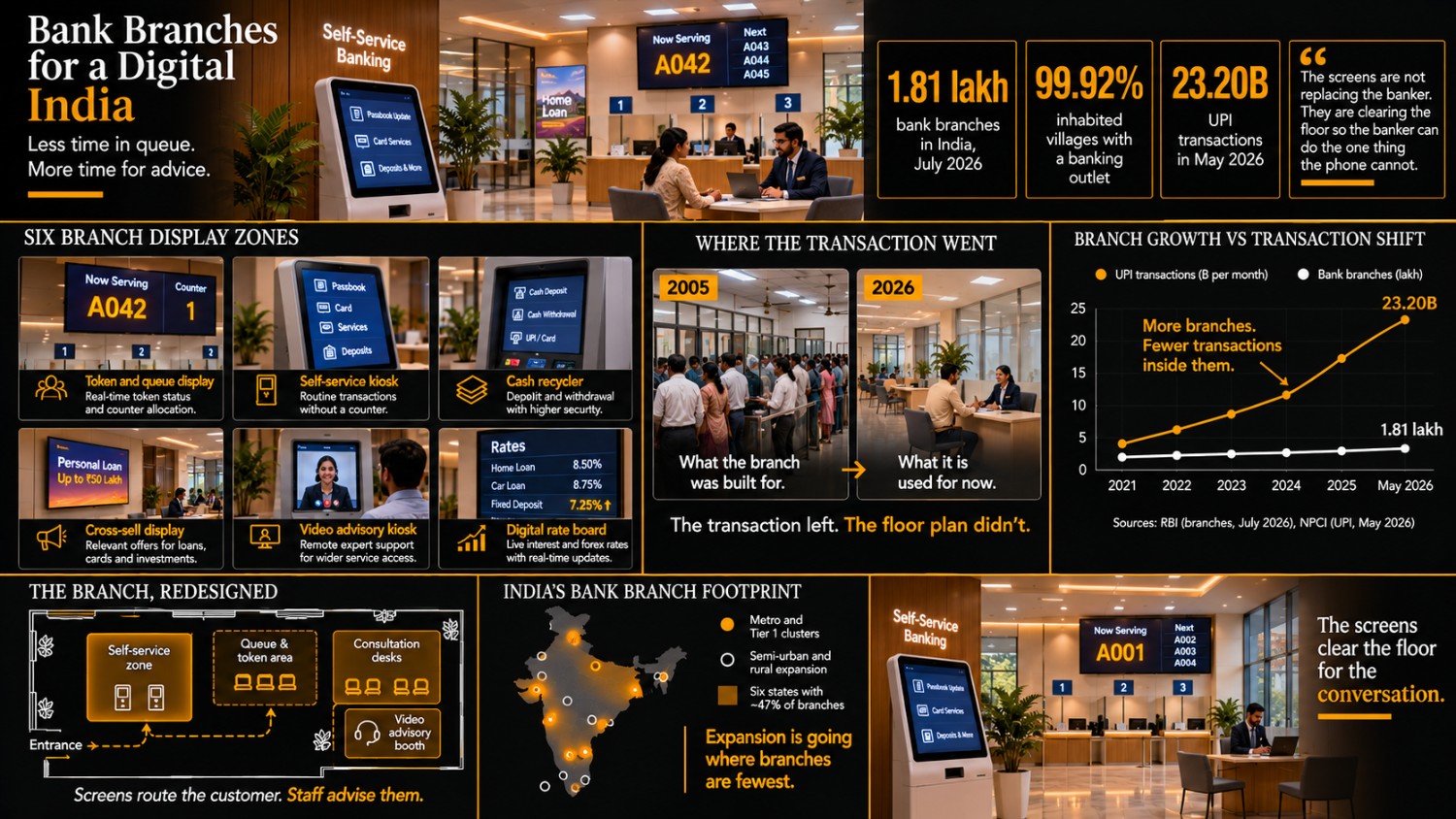
India has 1.81 lakh bank branches, 17.36 lakh business correspondents, and 99.92% of its inhabited villages within reach of a banking outlet. The transaction has moved to the phone. What is left in the branch is the conversation, and a branch built for deposits and withdrawals is not built for it.
Welcome back to Beyond the Screen. This edition we step into the Indian bank branch, a space being redesigned around a different job: less counter, more advice, and a lot more screens doing the work in between.
🔲 The big picture: more branches, fewer transactions inside them
As of July 2026, India had over 1.81 lakh bank branches, 17.36 lakh business correspondents, and 1.65 lakh India Post Payments Bank centres. Of the country’s 6,01,328 inhabited villages, 6,00,868 are served by a banking outlet. By one measure the network grew more than 15% between 2022 and 2026, and nearly 47% of branches sit across just six states. India has roughly 12 branches per lakh people.
At the same time, the transactions have left the building. In May 2026, UPI processed 23.20 billion transactions worth ₹29.90 lakh crore across 720 banks. The country has over 2.1 lakh ATMs and cash recycling machines, 11.53 million PoS terminals, and 5.60 million micro-ATMs.
Banks are still expanding branches. The largest public sector bank plans 300 to 400 new ones a year, and a leading private bank plans 500 in FY27, mostly in semi-urban and rural markets. But the reason a customer walks into a branch has changed. The simple task is on the phone. The branch is for the loan, the investment, the problem that app support could not solve, and the first account for a customer who is not yet comfortable online.
By the numbers:
→ 1.81 lakh — bank branches in India, July 2026
→ 99.92% — inhabited villages served by a banking outlet
→ 23.20 billion — UPI transactions in May 2026 alone
🔲 What display technology is doing inside the branch
A bank branch used to be a counter, a queue, and a notice board. The modern branch uses screens to split those jobs: routine tasks go to self-service, and staff time goes to conversations that earn revenue.
Queue and token management
As covered in Edition 12, a digital token system with a display showing the current number, counter assignment, and estimated wait is among the highest-impact, lowest-complexity deployments in any service environment. In a bank branch, it also tells the customer how long the wait is. That helps both the customer and the staff.
Self-service kiosks and cash recyclers
Passbook printing, statement requests, cheque deposits, card issuance, and account opening are being moved to kiosks. One public sector bank recently demonstrated an Android-based cash recycler that handles cash transactions, UPI-based cardless withdrawals, Green PIN generation, and instant debit card issuance on a single platform. A kiosk that does five things replaces five queues.
In-branch cross-sell and engagement displays
Branch screens are shifting from static posters to targeted product content. The same bank showed a platform that tracks visitor activity, product interest, dwell time, and conversion in the branch, giving managers a dashboard that a poster never could. A screen that shows a home loan offer to a customer standing in front of the loan desk is selling. A poster is decoration.
Video-assisted advisory
Smaller branches and digital-first formats use video kiosks to connect a customer to a remote expert for loan, investment, or insurance queries. This puts specialist advice into a Tier 3 branch that could never staff a specialist full time.
Rate boards and dynamic information
Interest rates, forex rates, and scheme details change often. A digital rate board updated centrally removes the printed notice, the delay, and the compliance risk of a branch showing last week’s rate.
Wayfinding, safety, and regulatory communications
Larger branches and regional offices use wayfinding screens, and every branch carries mandated customer notices and fraud-awareness messaging. A digital display managed from the head office delivers the same message to every branch the same day.
🔲 The India-specific angle: the phygital branch, rural reach, and the first-time customer
The phygital branch is arriving
In May 2026, a small finance bank opened what it describes as India’s first AI-powered phygital branch in Guwahati, combining AI-enabled self-service kiosks, paperless banking, and digital onboarding. The phrase marks a format: a small-footprint branch where most of the floor is self-service and a few staff handle exceptions. One case study of a large private bank’s branch-of-the-future programme reported digitising 75% of manual processes and cutting branch footfall by 90%.
Rural and semi-urban branches are where the new build is
Because the new branches are going into semi-urban and rural India, the display requirement there is different. Customers are often first-time or low-frequency visitors, language varies by state, and many are not comfortable with an app. A kiosk or screen in a rural branch has to explain itself, speak the local language, and guide someone through a process without a staff member’s help. Over 100 Digital Banking Units are already operating in rural and semi-urban areas, and the business correspondent network adds more than 17 lakh touchpoints where a simple kiosk can make a difference.
The DPDP layer applies to every branch kiosk
As covered in Editions 12 and 23, India’s data protection rules carry a compliance deadline in May 2027. Branch kiosks that capture Aadhaar details, biometrics, and financial data fall inside it. For bank technology teams planning a kiosk or display refresh, consent capture, data retention, and audit logs are procurement requirements, not options.
Trust is the product
A bank branch is one of the few places where a customer is handing over money or personal data. The environment, including its screens, signals reliability. A dated screen, a dead kiosk, or a blank monitor reads as a bank that has not invested. A clean, working, multilingual display reads as one that has.
🔲 Three signals worth tracking
1. The branch floor is being redesigned around advice
As transactions move out, floor space shifts toward consultation areas, relationship desks, and self-service zones. Display technology is the connecting layer: queue screens, kiosk zones, and product displays that route the customer to the right place.
2. Branch analytics will matter as much as branch sales
A platform that measures footfall, dwell time, product interest, and conversion turns a branch from a cost centre into a measurable sales channel. Display networks that feed this data are the sensor layer for it.
3. The business correspondent network is the largest untapped kiosk base
With over 17 lakh business correspondents, India has the world’s biggest last-mile banking network. Most operate with minimal infrastructure. Even a simple, standardised, multilingual display or kiosk at that scale would change what rural banking looks like.
🔲 Closing thought
For most of its history, the bank branch was built around a counter. The customer came to the bank to do something only the bank could do.
That is no longer true. The customer can transfer money, pay bills, and check a balance from a phone. What they cannot do on a phone is feel certain about a decision involving their savings, their home, or their family’s future.
The screens in the branch are not replacing the banker. They are clearing the floor so that the banker can do the one thing the phone cannot.
Until next time — stay switched on.