The Screen That Thinks: What AI Is Actually Doing to Digital Signage in 2026
For most of its commercial history, digital signage has been a smarter version of a poster. You upload content, set a schedule, and the screen plays it. The “digital” part meant the content could change without printing anything, but the logic underneath was the same as a lightbox with a timer.
That is changing. Not in the speculative, “the future is coming” sense that technology coverage often defaults to, but in ways that are already in production, already deployed, and already measurable in markets that have moved faster than India on this curve.
Understanding what AI is actually doing to digital signage, as opposed to what vendors are claiming it will do, is increasingly relevant for any operator planning a deployment in 2026 or beyond. Because the decisions made now about CMS architecture, hardware compatibility, and content strategy will either enable these capabilities or foreclose them.
What Has Actually Changed
The phrase “AI-powered signage” has been used loosely enough that it’s worth being specific about what the technology is actually doing in live deployments today.
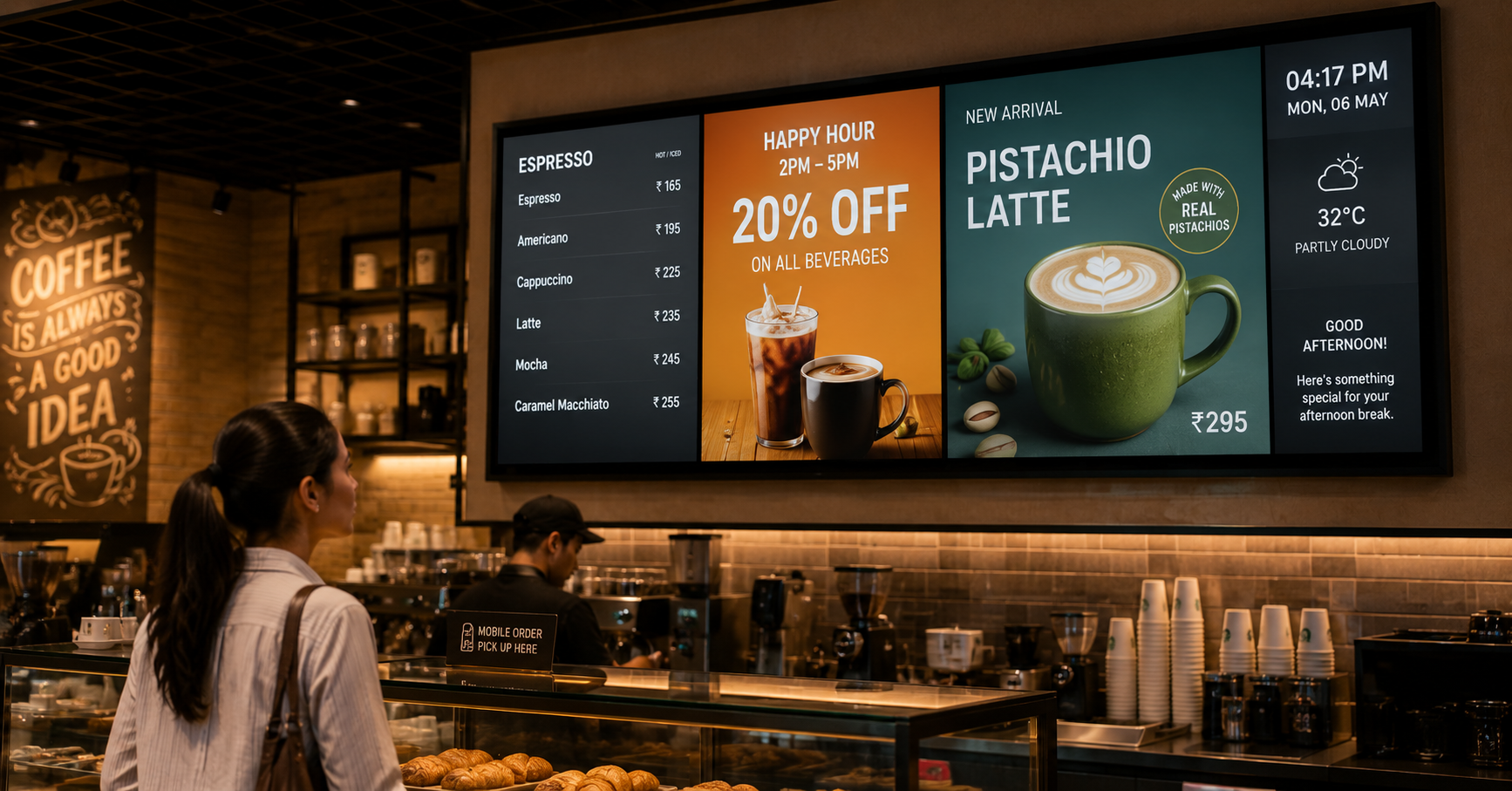
Audience analytics without personal identification. Camera-based sensors at the display can now analyse the demographic profile of viewers, approximate age range, gender distribution, group size, in real time, without storing or transmitting personally identifiable information. The system processes and discards; what it retains is aggregate data. A screen serving a coffee shop at 8 AM that detects a predominantly professional, solo audience can serve different content than the same screen at 3 PM when the audience skews younger and is arriving in groups. This is not facial recognition in any privacy-invasive sense, it’s audience sensing, and it’s already operational in retail and QSR environments globally.
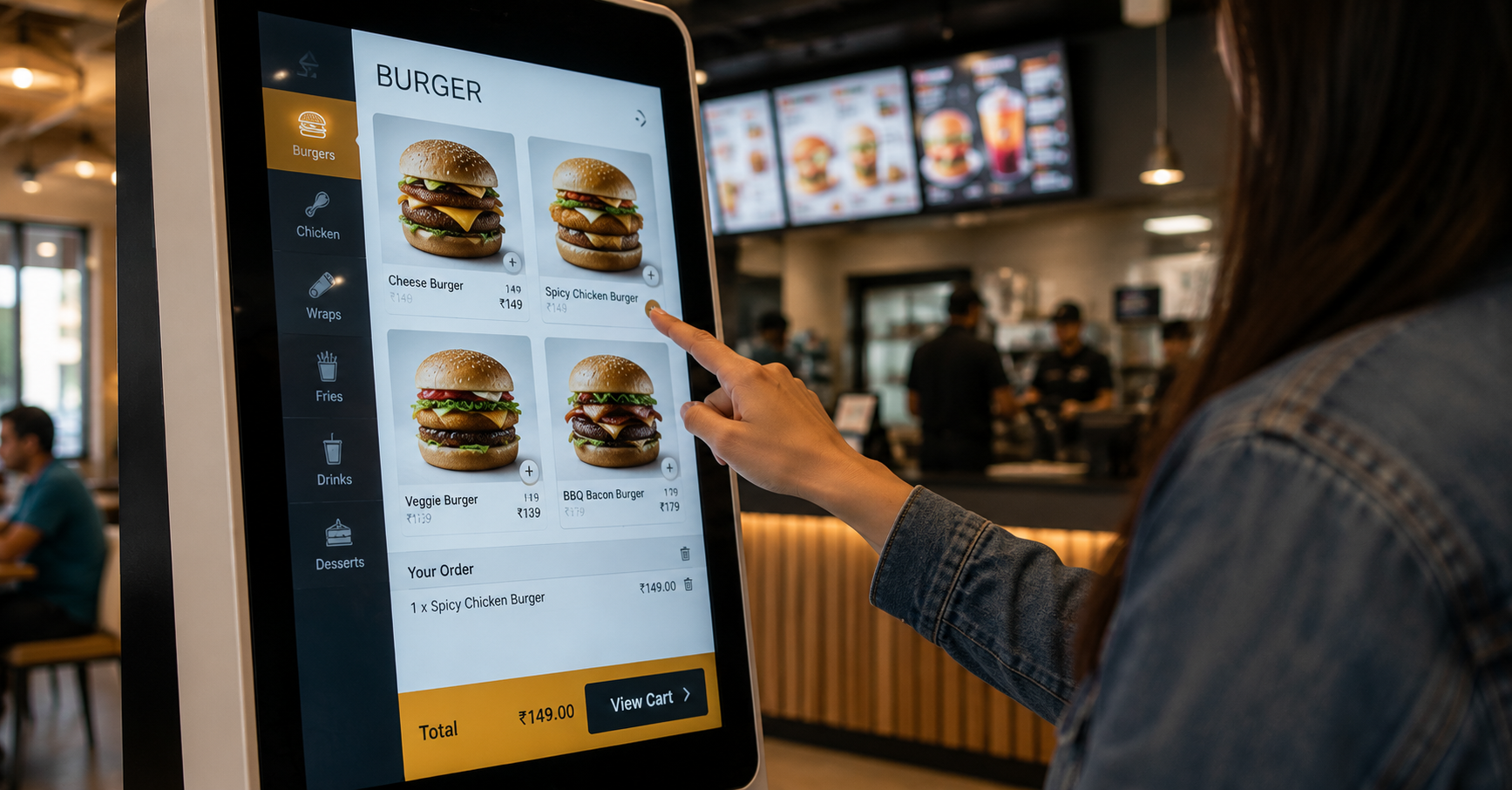
Trigger-based content switching. Integration between signage CMS platforms and external data feeds allows content to respond to conditions rather than just schedules. A QSR screen connected to its POS can automatically suppress promotion of a sold-out item. A retail display connected to a weather API can shift from sunscreen to moisturiser content when the temperature drops. A corporate lobby display can pull from a live calendar feed and switch from brand content to event welcome messaging when a scheduled visitor booking is active. These are not complex AI systems, they are rule-based automations, but they represent a meaningful shift from the schedule-only logic that governs most current deployments.
Generative content creation. Retail, restaurant, and financial services brands are now generating content variants directly inside content management systems. A manager sets brand parameters, tone, and compliance rules, and receives multiple content options that have been automatically validated against brand guidelines. The gain is speed and scale: campaigns that previously required agency production cycles can be adapted and versioned in hours. For operators running promotions across multiple outlets with local variations, this changes the economics of content production significantly.
Predictive scheduling. Rather than manually setting content schedules based on historical assumptions about when certain audiences are present, AI-driven platforms can analyse footfall patterns over time and recommend, or automatically implement, content scheduling that matches what the data actually shows about audience composition by time, day, and location.
What This Means for Indian Operators
Global adoption curves in digital signage technology tend to reach India with a lag, but the lag has been compressing. The infrastructure conditions that previously slowed adoption (connectivity reliability, hardware costs, CMS sophistication) are improving, and the operators who invest in the right foundations now are better positioned to activate these capabilities as they become accessible.
A few implications worth thinking through:
CMS architecture matters more than it did. A content management system that only supports manual content upload and time-based scheduling cannot support trigger-based automation or audience analytics. Operators choosing a CMS today are effectively choosing whether these capabilities will be available to them in two years, or whether they’ll need to replace the platform to access them. The question to ask is not just “can it do what I need today?” but “is it API-open and integration-ready for what I’ll want it to do in 2027?”
Content strategy needs to evolve alongside the technology. The value of trigger-based content or audience-adaptive messaging depends entirely on having content that’s actually designed to change. A single looping creative can’t respond to a sold-out item or a different audience demographic. Operators who want to use these capabilities need to invest in modular content, a library of assets that the system can draw from and combine based on conditions, rather than a single produced video that runs regardless of context.
Data governance is a real consideration. Audience analytics using camera sensors is a capability that comes with responsibility. In the Indian regulatory context, this is not yet as formally structured as GDPR in Europe, but the ethical principles are the same: aggregate data only, no personal identification, transparent operation. Operators deploying camera-enabled displays should have a clear policy on what data is collected, how long it’s retained, and who has access.
The Part That’s Still Overhyped
It’s worth being honest about where the gap between vendor claims and production reality remains significant.
Hyper-personalisation at the individual level, content that adapts to a specific person rather than a demographic group — is technically feasible in controlled environments but operationally complex and ethically fraught in most real-world retail or public settings. The more credible near-term capability is audience-level adaptation, not individual-level.
Fully autonomous AI content generation, systems that create and deploy content without human review, carries real risk. Multilayered review has become the standard: one AI generates, another checks, and the final approval is human. Any operator considering generative AI in their content workflow should build in human sign-off, not remove it.
Seamless POS and ERP integration is frequently described as a solved problem in vendor presentations. In practice, integration quality varies enormously depending on the legacy systems involved, and “integration-ready” in a CMS often means “we have an API” rather than “we have a working connector for your specific system.” This is an area where live reference deployments are the only credible evidence.
The Practical Takeaway
AI in digital signage is not a future state. It’s a present one, in some markets, for some operators, in some specific applications. In India, the adoption is earlier stage, but the direction is clear.
For operators planning deployments in 2026, the practical implication is not to wait for AI capabilities before deploying. It’s to deploy with infrastructure that doesn’t lock you out of those capabilities as they become relevant. That means CMS platforms with open APIs and integration capability, hardware that supports sensor add-ons where relevant, and content strategies built around modularity rather than single-file creative production.
The screen is getting smarter. The operators who benefit most will be the ones who understood that the software, the data, and the content strategy were always the real investment, and planned accordingly.
If you’re planning a digital signage deployment and want to understand how to build for current needs while staying open to where the technology is heading, we’d be glad to walk through what that looks like in practice.
Get in touch: contact@techworksworld.com | +91-99109 65918 | techworksworld.com