More Than a Notice Board: What Digital Displays Are Doing on Indian Campuses
The notice board outside the administrative block has been a fixture of Indian campuses for decades. Printed circulars pinned in layers, yesterday’s announcement obscuring last week’s exam schedule, a timetable change that three departments know about and the rest of the campus doesn’t.
It works, in the loosest sense of the word. Information gets posted. Whether it reaches the right people at the right time is a different question entirely.
Campuses, schools, colleges, universities, professional institutes, and corporate training centres are communication-dense environments. A large university might be coordinating hundreds of events, timetable changes, exam notifications, placement drives, cultural announcements, and administrative deadlines across dozens of buildings and thousands of students simultaneously. The infrastructure that most of them use to manage this communication was designed for a different era.
Digital displays on campuses are not a cosmetic upgrade to the notice board. When deployed with intent, they’re a communication infrastructure investment that changes how information moves through an institution and, by extension, how the institution functions and is experienced by the people inside it.
Where the Communication Gaps Actually Are
Before specifying any display technology for an educational environment, it’s worth mapping where communication actually breaks down.
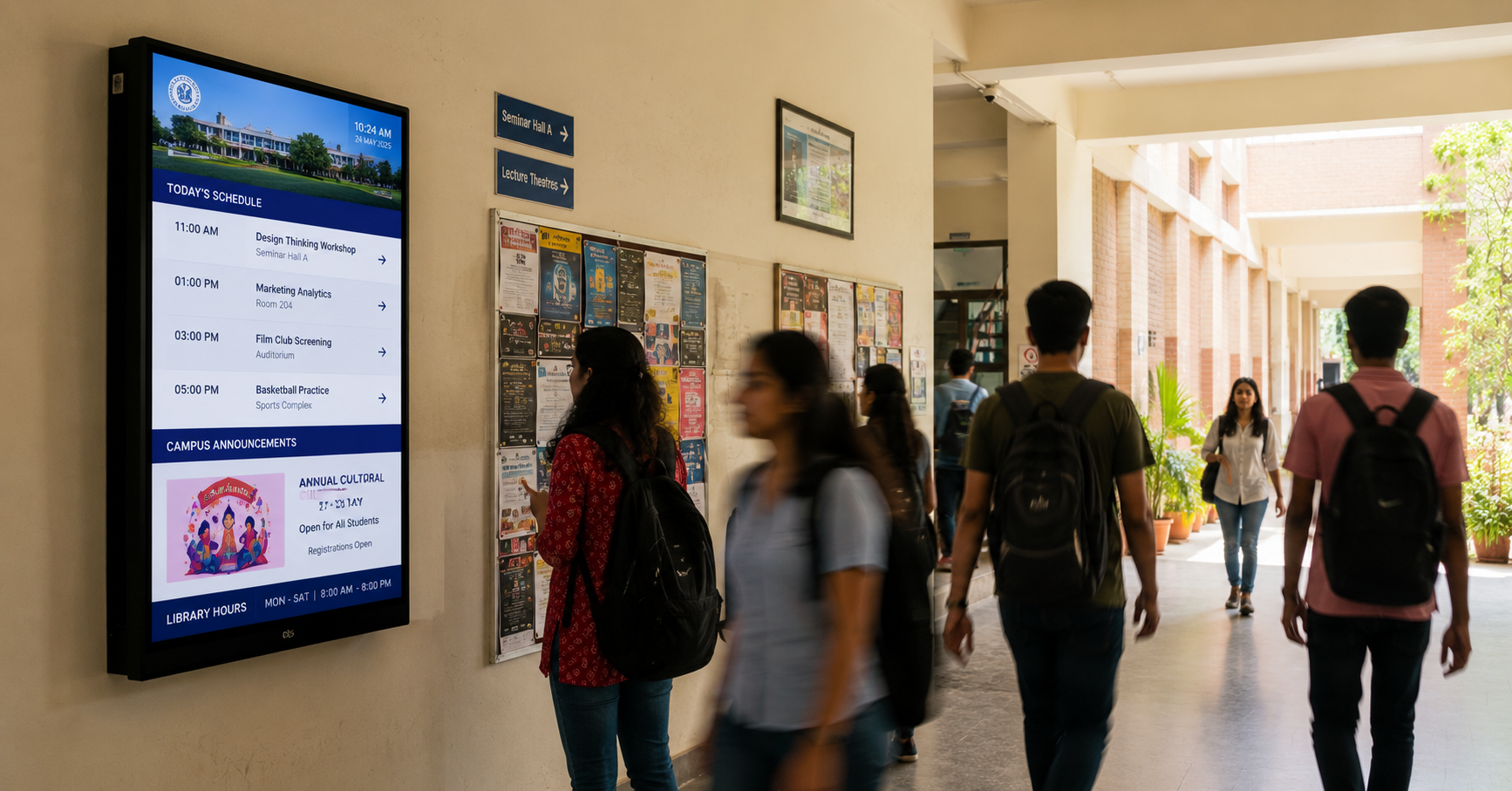
Timetable and venue changes are among the most operationally disruptive communication failures on any campus. A lecture moved to a different room, a lab session rescheduled, an external speaker added at short notice in most institutions, this information travels through WhatsApp groups, word of mouth, and occasionally a notice pasted on the original room’s door after students have already arrived and left. A display outside each lecture hall or classroom block showing the current day’s schedule updated in real time from the timetable system eliminates this failure mode almost entirely.
Event communication suffers from the opposite problem: important events are communicated too far in advance through channels that aren’t visible at the relevant moment. A placement drive happening on Wednesday was announced in an email two weeks ago. By Wednesday, most students have forgotten. A display in the hostel common room, the library entrance, and the canteen showing “Placement drive [Company], Hall 4, 10 AM today” reaches students at the moment it’s actionable.
Wayfinding on large campuses is an underestimated friction point, particularly for new students, visiting faculty, parents during admission season, and external recruiters. A campus with multiple buildings, departments, hostels, and administrative blocks spread across significant area needs directional infrastructure that goes beyond painted arrows and hand-drawn maps at the gate. Digital directories at key entry points and campus junctions provide navigational clarity that scales as the campus grows and changes.
Emergency and safety communication requires a channel that can reach everyone in a building simultaneously, without depending on anyone checking a phone or reading a notice. A digital display network with centrally-controlled override capability where a single action pushes an alert to every screen on campus is the kind of infrastructure that most Indian educational institutions currently lack and that becomes significantly more valuable as campus populations grow.
Specific Applications That Work on Campus
Classroom and Department Entrance Displays
Small-format screens outside lecture halls, seminar rooms, and department offices showing today’s schedule for that room sessions, faculty, timing, any changes reduce the most common source of student confusion on large campuses. Updated automatically from the timetable system, with no manual intervention required once the integration is in place.
Library and Study Space Communication
Libraries are high-dwell environments where a captive audience sits for extended periods. Displays showing new acquisitions, database access guides, upcoming workshops, and quiet hour reminders reach students in a context where they’re stationary and receptive. For academic libraries managing resource allocation across multiple reading rooms, displays showing real-time seat availability by section are a practical addition that reduces the time spent searching for a place to study.
Placement and Career Services
For institutes where placement outcomes are a significant part of the brand proposition, a dedicated display network in high-traffic student areas canteen, hostel common rooms, department corridors can run placement-specific content: upcoming company visits, pre-placement talk schedules, registration deadlines, offer announcements. This kind of always-visible communication keeps placement activity present in student consciousness without competing with every other announcement in a WhatsApp group.
Administrative and Visitor Areas
For the administrative block, registrar’s office, and admission areas spaces that handle significant visitor traffic, especially during admission season displays showing queue status, counter assignments, document checklists, and process guidance reduce the volume of repetitive queries handled by staff. For visitors and prospective students, a well-managed display environment communicates institutional quality as effectively as the physical infrastructure does.
Campus Events and Cultural Communication
Student bodies, cultural committees, and sports departments generate significant communication volume that currently competes for physical notice board space. Digital displays with role-based access where student council members can push approved content to designated screens give student organisations a formal communication channel that doesn’t depend on printing or physical access to notice boards. It also allows the institution to maintain content quality standards while enabling student-generated communication.
The Multi-Building, Multi-Campus Challenge
For universities with multiple colleges across a shared campus, or for educational groups operating several institutions across cities, the operational case for centralised content management mirrors what’s already true for retail chains and hospitality groups.
A centrally managed display network allows an administrative team at the main campus to push institution-wide announcements to all locations simultaneously. Individual departments or colleges retain the ability to manage their own local screens timetable updates, department events, faculty notices within a framework set by the central institution. Brand consistency, content standards, and emergency communication capabilities are maintained centrally; local relevance is preserved locally.
This is the model that most large Indian universities would benefit from and the CMS architecture that makes it possible is the same as in any multi-site deployment. The question, as always, is whether the software was chosen with this kind of distributed operation in mind.
Content That Works in an Educational Environment
Campus display content has a different character from retail or QSR content. The audience is a community rather than a transient customer base the same students walk past the same screens every day for three or four years. Content that repeats without change becomes invisible within weeks.
This means the content strategy for campus displays needs to be genuinely dynamic tied to the institution’s actual calendar, updated with new information regularly, and varied enough that it rewards a second glance. The most effective campus display content is the most time-sensitive: today’s schedule, this week’s events, the deadline that’s three days away. Content that’s current is content that gets read.
It also means the update workflow needs to be genuinely manageable. A campus display network that requires IT department involvement every time a schedule changes will fall into disuse within a semester. The system needs to be operable by administrative staff, department coordinators, and student body representatives with appropriate access levels without technical knowledge or vendor support.
Where to Start
For educational institutions beginning a display rollout, two locations tend to deliver the most immediate and visible return:
The first is classroom and lecture hall entrance displays connected to the timetable system. The reduction in timetable-related confusion is immediate, measurable, and appreciated by both students and faculty.
The second is the main campus entrance and administrative block a directory display and an announcements screen in the highest-footfall location on campus. Visible to everyone who enters, updated centrally, and immediately communicating that the institution has invested in its communication infrastructure.
Both establish the CMS foundation and operational discipline that makes subsequent expansion to hostels, canteens, department corridors, and specialist spaces straightforward rather than a new project from scratch.
If you’re planning a digital display rollout for an educational campus whether a single-building institute or a multi-college university we’d be glad to walk through what a practical deployment looks like.
Get in touch: contact@techworksworld.com | +91-99109 65918 | techworksworld.com