Four Sides, No Back: What an LED Cube Does That a Flat Screen Cannot
Most display thinking is flat. A screen has a front, a wall, and a viewer standing in front of it. The relationship is directional: the content faces one way, the audience faces back.
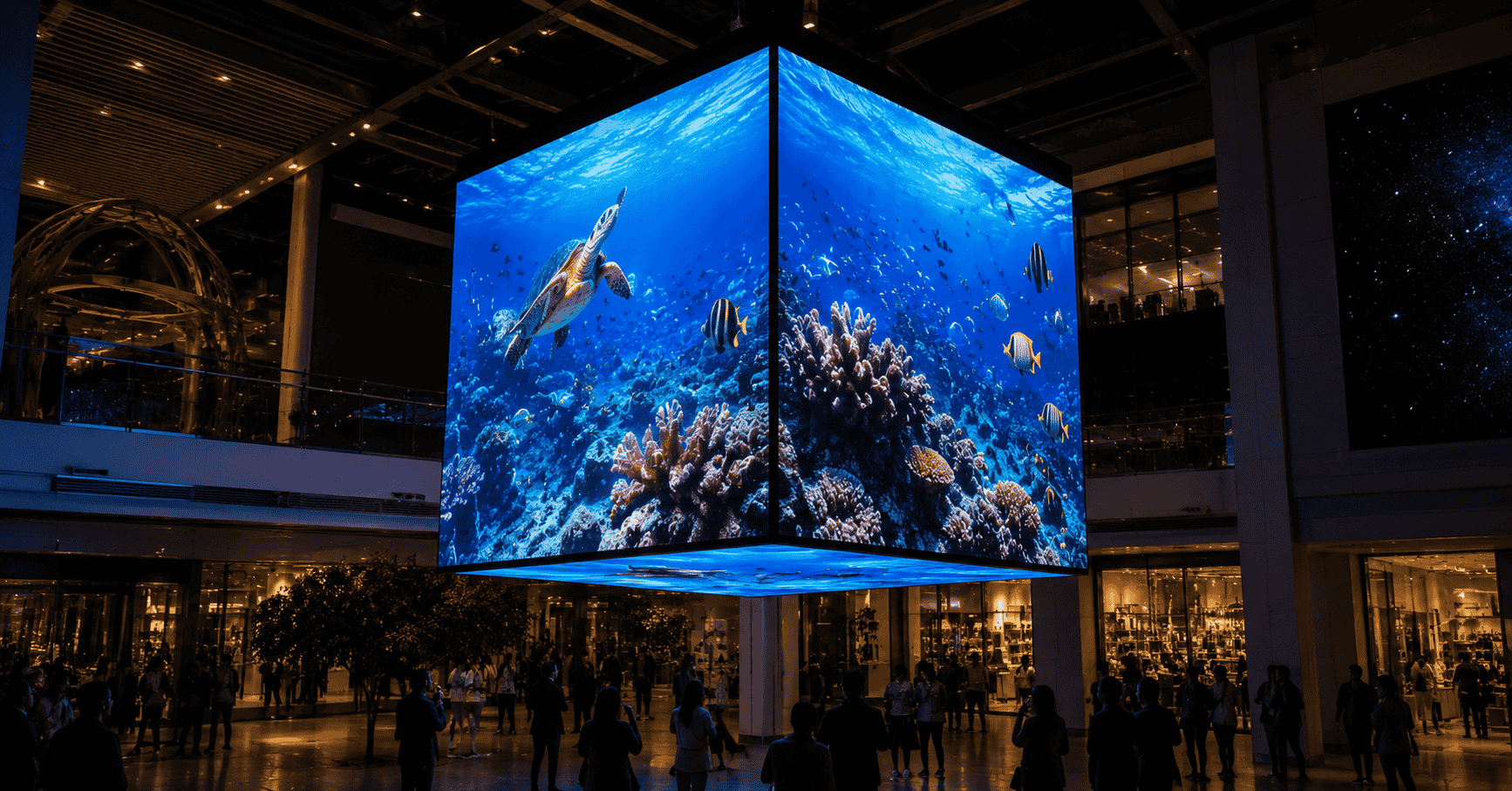
An LED cube breaks that assumption entirely. Four sides, sometimes five, including the base each displaying content simultaneously, viewable from any angle, suspended or standing in open space. It is, in the most literal sense, a display with no back.
This is not a trivial difference. It changes what the display can be used for, where it can be placed, and what kind of audience experience it creates. And it positions the LED cube in a specific set of applications where flat screens regardless of size, resolution, or brightness cannot replicate what the format achieves.
What the Format Actually Is
An LED cube is a modular, multi-sided display structure assembled from LED panels on each visible face. The form factor is typically cubic equal dimensions on each side though rectangular and custom configurations exist. Sizes range from compact installations of under a metre per side to large-format suspended cubes several metres across, depending on the application.
The defining structural characteristic is that the display has no dominant viewing axis. A flat screen privileges the viewer standing directly in front of it; anyone to the side or behind gets a partial or obstructed view. A cube is visible and legible from 360 degrees in the horizontal plane. Suspended versions extend this to viewing from above making them effective in environments where audiences are distributed across multiple levels, or where the display needs to anchor a space without being tied to a wall.
Content on a cube can be coordinated across faces the same image wrapping continuously around all four sides or differentiated, with each face showing distinct content suited to the audience approaching from that direction.
Where LED Cubes Deliver What Flat Screens Cannot
Retail and Mall Environments
In a shopping centre atrium or a large-format retail space, the challenge of any display installation is audience distribution. People approach from multiple directions, at multiple levels, on multiple floors. A wall-mounted screen serves the audience on one side of the atrium. A suspended cube serves everyone regardless of which entry point they used, which floor they’re on, or which direction they’re walking.
For brand activations and campaign moments in high-footfall retail environments, the LED cube commands space rather than occupying wall space. It becomes an event in the environment rather than a feature of the architecture. This is the distinction that matters for brands using digital displays as a tool for creating attention rather than simply communicating information.
Exhibitions and Trade Shows
In exhibition environments where every stand is competing for the attention of visitors who are perpetually distracted, a suspended or standing LED cube is visible from multiple aisles simultaneously. The footfall-per-impression calculation is fundamentally different from a flat screen facing a single direction the same content investment reaches audiences approaching from four directions at once.
For product launches, brand activations, and flagship exhibition presence, the cube format signals investment and intent in a way that even a large flat screen cannot. It occupies vertical space, creates a landmark in the floor plan, and gives the brand a visible anchor that can be found from across the hall.
Corporate and Brand Experience Centres
Flagship offices, experience centres, and innovation labs spaces designed to communicate brand identity to visitors, clients, and recruits increasingly use large-format display installations as part of the spatial design rather than as additions to it. An LED cube in the central atrium of a corporate campus doesn’t just show content; it defines the character of the space, creates a focal point for visitor orientation, and communicates the kind of investment in environment that reinforces brand positioning.
The 360-degree visibility means the cube works regardless of how visitors move through the space there is no suboptimal viewing position, no corner of the room where the display is less effective.
Events and Activations
For temporary brand activations, product launches, and experiential marketing events, the LED cube is one of the few display formats that is genuinely portable at large scale while delivering visual impact proportionate to the space. Modular panel construction means the cube can be assembled, configured, and disassembled by an installation team making it viable for events with a defined duration rather than requiring permanent infrastructure.
The content flexibility also suits event applications: coordinated content across all four faces creates an immersive environment rather than a display. When the content is designed for the format, the viewer is surrounded rather than addressed.
Content Design for a Cube: What Changes
The creative brief for an LED cube is categorically different from a flat screen brief, and this distinction is frequently underestimated.
Wrap-around content a single visual that flows continuously across all four faces requires content designed in a cylindrical or panoramic format rather than a standard aspect ratio. A flat image cropped and tiled across four sides will show visible seams and compositional breaks at every corner. Content created for the format treats each corner as a transition rather than a boundary.
Face-differentiated content distinct creative on each face, suited to the audience approaching from that direction requires more production investment but allows more contextual relevance. In an exhibition environment, for example, each face might address a different audience persona or product line, with visitors getting a different message depending on which aisle they’re arriving from.
Motion and continuity are more important on a cube than on a flat screen. The viewer is constantly in motion relative to a 360-degree display approaching, passing, circling. Content that rewards this movement animations that evolve as the viewer moves around the cube, visual elements that connect across faces creates a fundamentally different experience from static or minimally animated content.
Brightness and ambient conditions need more careful calibration. A cube suspended in a high-ceiling atrium with variable ambient light across different faces one facing a window, one in relative shadow requires brightness management that flat screen installations in controlled viewing conditions don’t encounter.
What to Verify Before Specifying
Viewing distance and pixel pitch. A cube designed for a large atrium at 10-20 metre viewing distances requires a different pitch specification from one intended for close-range engagement at a trade stand. Getting this wrong in either direction too fine a pitch for a large-distance installation (unnecessary cost) or too coarse for a close-range one (visible pixelation) is an avoidable specification error.
Structural requirements. A suspended cube has load and rigging requirements that need to be verified against the ceiling structure of the installation location before the project is specified. This is not a post-installation consideration it shapes site selection and structural briefing from the outset.
Content production capability. The question “who is producing content for this, and have they produced for a cube format before?” is more important for this format than for any other. A cube with generic flat-screen content repurposed across four faces is a significant investment delivering a mediocre outcome. The hardware and the content brief need to be scoped together.
The Right Use Case
An LED cube is not the right format for every high-impact display need. It’s a premium, application-specific format that delivers maximum value in environments where:
- The audience approaches from multiple directions and no single viewing axis dominates
- The display needs to define or anchor a space, not just communicate within it
- The brand or event context justifies the visual statement the format makes
- The content production investment matches the hardware investment
When these conditions are met, no flat screen of equivalent size delivers the same combination of visibility, spatial presence, and audience reach. When they’re not, a well-specified flat screen is almost always the better choice.
If you’re planning an experiential display installation for a retail environment, a corporate space, an event, or an exhibition stand and want to understand whether an LED cube is the right format for the specific application, we’d be glad to walk through it.
Get in touch: contact@techworksworld.com | +91-99109 65918 | techworksworld.com