Waiting Rooms, Wayfinding, and Ward Rounds: Digital Displays in Healthcare Environments
A patient sitting in a hospital waiting room has one primary need: to know what is happening and when. Is their name next? Has the doctor been delayed? Which counter do they go to after this? Is the pharmacy on the ground floor or the first?
These are not complex questions. But in most Indian healthcare facilities — public hospitals, private clinics, diagnostic chains, multi-speciality centres — they go unanswered for long stretches of time, creating anxiety that compounds an experience already weighted with stress.
Digital displays in healthcare environments don’t cure anything. But they address something that matters enormously in a clinical setting: the experience of waiting, and the quality of information available during it. For facility managers and hospital administrators focused on patient satisfaction scores and operational efficiency, this is where the investment case begins.
The Waiting Room Problem
Healthcare waiting is unlike waiting anywhere else. The uncertainty is higher, the emotional stakes are greater, and the absence of information is experienced as a form of neglect — even when the clinical care being delivered is excellent.
Research in patient experience consistently shows that perceived wait time is significantly lower when patients are given accurate information about queue status and expected delays. A patient who knows they are fourth in the queue and the doctor is running fifteen minutes late experiences that wait differently from a patient who knows nothing except that their appointment was at 11 AM and it is now 11:35.
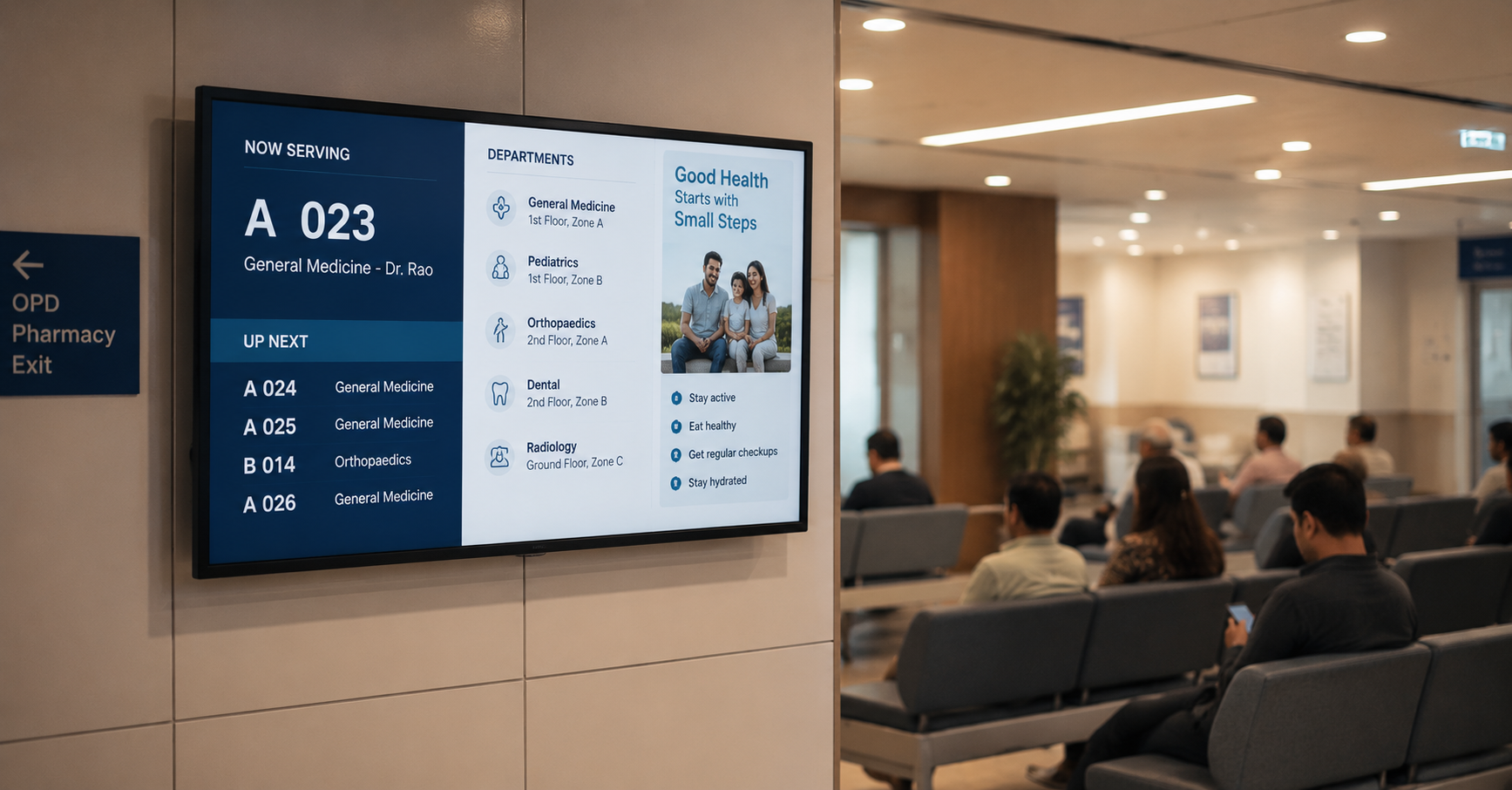
Token management systems paired with digital queue displays address this directly. When a patient takes a token at registration, they can see their number on a display in the waiting area, track how many tokens are ahead of them, and understand when they’re likely to be called. The uncertainty doesn’t disappear, but it becomes bounded — and bounded uncertainty is categorically less stressful than open-ended uncertainty.
Beyond Queue Management: What Else the Wait Can Do
Waiting room dwell time in healthcare is among the highest of any environment — often thirty minutes to an hour or more. This is time that most facilities currently fill with a television showing news or a cable channel that may or may not be appropriate for a clinical setting.
Digital displays in waiting areas can use this time more constructively:
Health education content. Condition-specific information relevant to the department — common symptoms, treatment overviews, post-procedure care instructions, preventive health guidance. A patient waiting in an orthopaedic OPD and watching content about joint care and physiotherapy is being prepared for a more informed consultation, not just passed time.
Facility information. Pharmacy location and timings, diagnostic centre hours, insurance desk procedures, appointment booking process, specialist clinic schedules. Information that reduces the number of questions staff have to answer repeatedly, freeing capacity for clinical interactions.
Administrative guidance. Documents to carry for next visits, how to access reports online, feedback submission process. The waiting room is one of the few moments patients are stationary and attentive — it’s an underused opportunity to reduce downstream administrative friction.
The content here needs to be managed carefully. Healthcare communication has regulatory and ethical considerations that don’t apply in retail or hospitality — promotional content for treatments or procedures, for example, requires careful framing. The strength of this format is in genuinely useful, neutral health information, not commercial messaging disguised as patient education.
Wayfinding in Large Healthcare Facilities
Multi-speciality hospitals and large diagnostic chains have a wayfinding problem that rivals airports in complexity — multiple floors, multiple departments, multiple consultation wings, outpatient and inpatient zones, diagnostic and pharmacy areas, sometimes multiple buildings across a campus.
Static signage handles the permanent structure but fails immediately when departments relocate, temporary clinics are added, or a specific OPD moves to accommodate an event or renovation. Digital wayfinding displays at key junctions — main entrance, elevator banks, inter-floor landings — can be updated centrally when layouts change, without a facilities team repainting arrows or reprinting floor maps.
For larger campuses, interactive directory kiosks at the entrance allow patients and visitors to search for a doctor, department, or service and receive step-by-step directional guidance — reducing the volume of navigation queries handled by security and reception staff, particularly during peak outpatient hours.
Clinical and Operational Displays
Beyond patient-facing applications, digital displays serve a set of purely operational functions within healthcare facilities that are distinct from the patient experience use cases above.
OT and procedure scheduling boards. In surgical suites and procedure areas, displays showing theatre schedules, patient sequences, and status updates allow clinical teams to coordinate without relying on verbal handoffs or printed schedules that become outdated the moment a case runs long.
Ward and nurse station displays. Bed occupancy status, patient alerts, round schedules, and task queues surfaced on displays at nursing stations reduce the dependency on paper-based handover systems and clipboard-carried information.
Emergency department status boards. In casualty and emergency settings, a display showing triage status, bed availability, and wait time by acuity level gives clinical coordinators situational awareness that’s difficult to maintain through verbal communication alone in high-volume periods.
These are not patient-facing — they’re internal clinical communication tools. But they draw on the same display infrastructure and content management systems as the patient experience applications, which means a facility that invests in a capable CMS for its waiting rooms is already most of the way to enabling operational displays as well.
The Compliance and Sensitivity Dimension
Healthcare is one of the few environments where content management carries genuine regulatory weight. Patient information, treatment references, and drug or procedure mentions may be subject to guidelines from the Medical Council of India, the CDSCO, or facility-specific ethical review processes.
This doesn’t make digital displays inappropriate for healthcare — it makes content governance more important. A capable CMS with role-based access, content approval workflows, and audit trails is not optional in a clinical environment; it’s the difference between a deployment that the clinical and administrative teams can trust and one that becomes a liability when content goes live without the right review.
For multi-facility hospital groups, this governance requirement also reinforces the case for centralised content control — a single team maintaining approved content libraries that individual facilities can draw from, rather than each location managing its own content independently with variable standards.
Where to Start
For healthcare facilities beginning a digital display rollout, two starting points tend to deliver the fastest visible return:
The first is the outpatient waiting area — queue display paired with useful health content. The patient experience improvement is immediate and measurable in satisfaction scores, and the content management requirement is manageable.
The second is facility wayfinding at the main entrance and key junctions. The reduction in navigation queries handled by staff is measurable within weeks, and the content update requirement is low once the initial directory is built.
Both of these establish the CMS infrastructure and operational discipline that makes subsequent phases — clinical displays, ward communication, multi-facility rollout — significantly easier to execute.
If you’re planning a digital display deployment for a healthcare facility — whether a single clinic, a multi-speciality hospital, or a diagnostic chain — we’d be glad to walk through what a phased rollout looks like in practice.
Get in touch: contact@techworksworld.com | +91-99109 65918 | techworksworld.com