What Are the Best Digital Display Solutions for Retail Stores?
If you’re evaluating digital display solutions for a retail store, the honest answer to “which is best?” is: it depends on where in the store, what you’re trying to achieve, and what your content management capability looks like.
There is no single best display for retail. There are formats that work well for specific applications and formats that look impressive in a showroom and underperform in practice because they were specified for the wrong job. This guide covers the main options, what each one does well, and how to decide which combination makes sense for a specific retail context.
The Display Formats Worth Considering for Retail
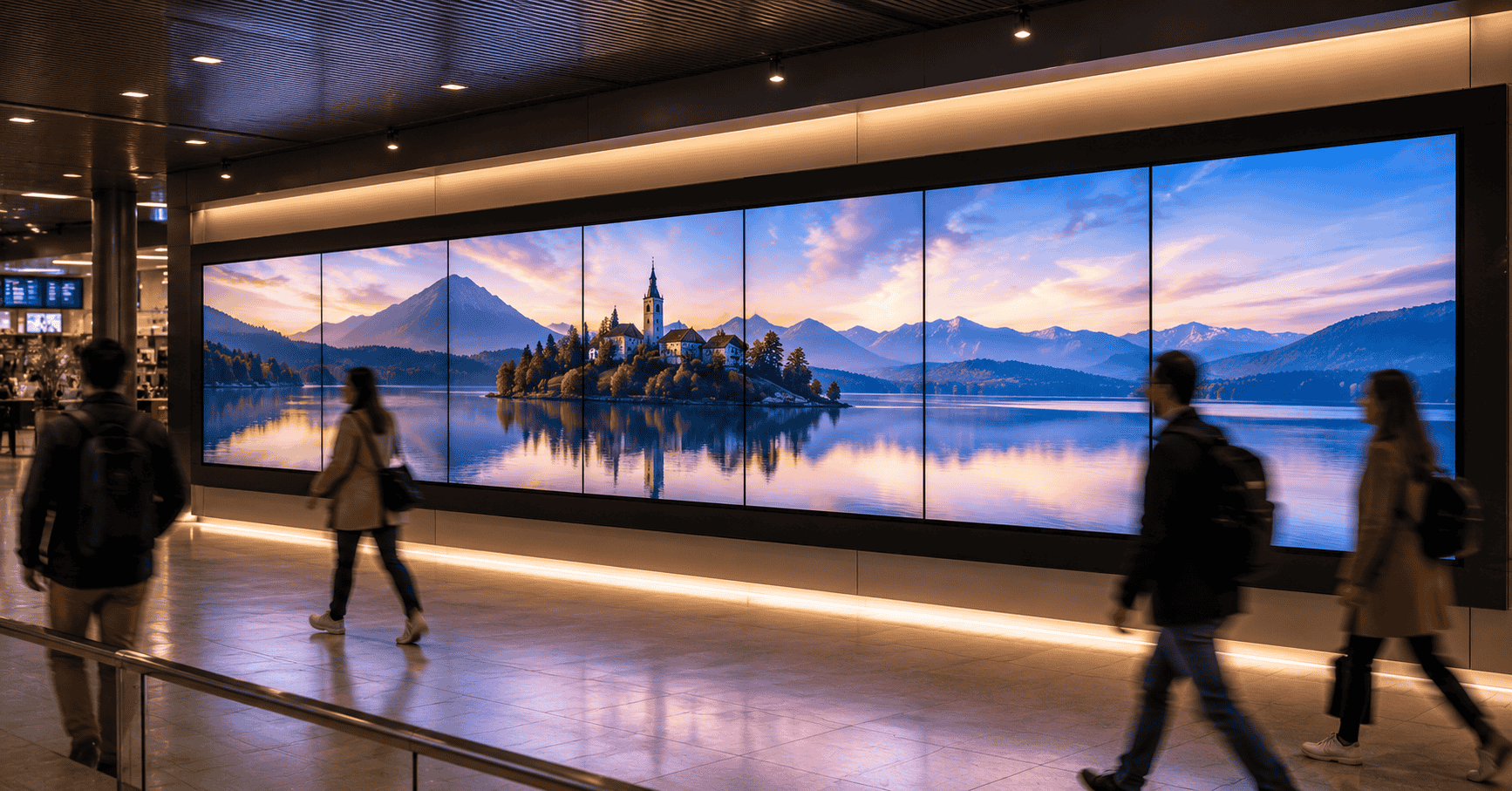
1. Video Walls
What they are: Multiple display panels tiled together to form a single large-format canvas, typically mounted on a feature wall.
Where they work best: Entrance zones, feature walls behind service counters, large-format brand environments in flagship stores or showrooms. Anywhere the goal is to create a brand environment rather than communicate a specific message.
Strengths: Visual impact at scale, high-brightness options available for well-lit retail environments, strong for brand storytelling and campaign content.
Limitations: Fixed installation content faces one direction and serves a defined audience position. Not appropriate for spaces where the audience approaches from multiple angles. Higher content production investment required to make full use of the format.
Best for: Premium retail, flagship stores, large-format electronics and furniture showrooms, brand experience centres.
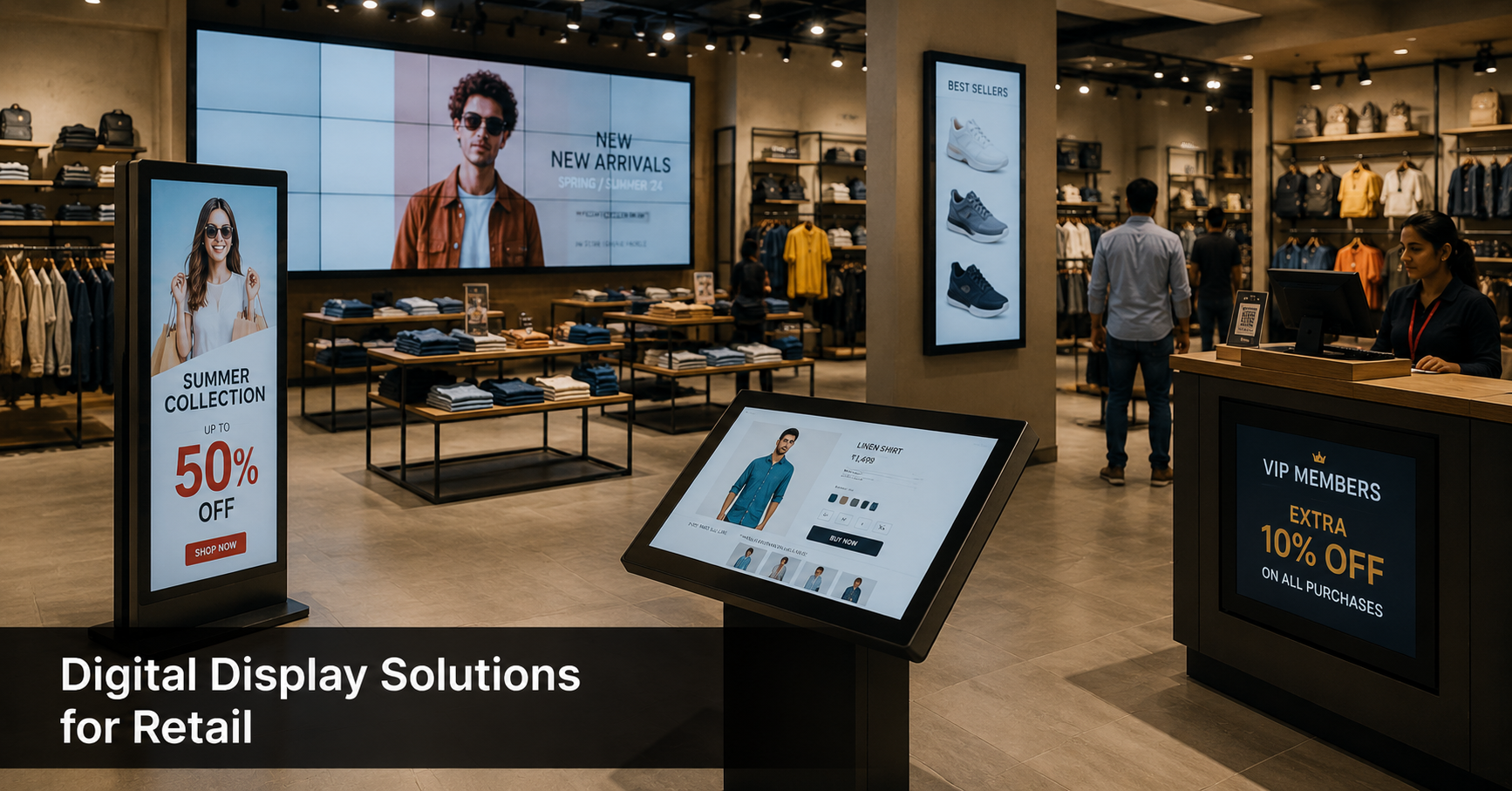
2. Digital Standees
What they are: Freestanding display units, typically 32 to 55 inches on a floor stand, portable and repositionable without structural installation.
Where they work best: Near entrances, at product category adjacencies, in queue areas, at gondola ends during campaign periods. Anywhere the optimal display position changes more frequently than a fixed installation can accommodate.
Strengths: Flexibility can be repositioned to follow a campaign or season. No wall installation required. Lower entry cost than fixed formats. Works in leased retail spaces where permanent wall fixings are restricted.
Limitations: Smaller format limits impact in large open-plan spaces. Requires stable placement in high-traffic areas to avoid tipping hazards. Cable management in open floor areas needs planning.
Best for: Mid-format retail, brand activations, seasonal promotions, QSR queue areas, pop-up retail environments.
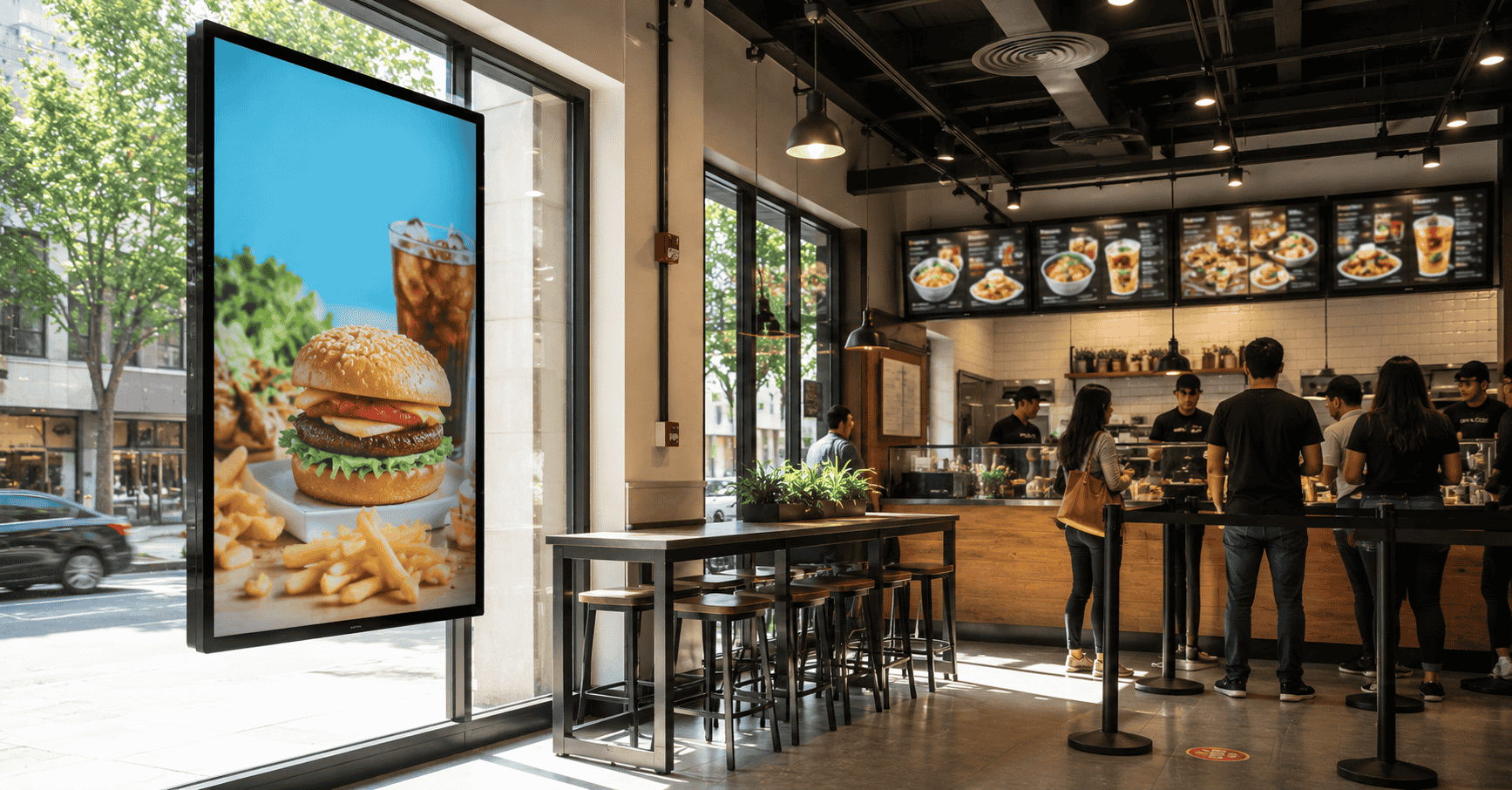
3. Transparent LED Displays
What they are: LED display panels with significant open space between LED clusters, creating a see-through effect, typically mounted in or behind glass shopfront windows.
Where they work best: Street-facing glass storefronts where the interior merchandise needs to remain visible while dynamic content is overlaid on the glass. Premium brand environments where the display itself contributes to the spatial aesthetic.
Strengths: Preserves window visibility while adding a live content layer. Visually arresting from the street, stops foot traffic. Content can be updated as frequently as any other digital display.
Limitations: Premium hardware cost. Ambient light conditions need careful assessment, insufficient brightness specification renders the display unreadable in strong sunlight. Not appropriate where close-range, high-resolution content is required. Background behind the display needs to be visually considered, not incidental.
Best for: Premium retail storefronts, jewellery and fashion flagships, beauty and skincare brand environments, high-street locations with significant foot traffic.
4. Lift-and-Learn / Interactive Shelf Displays
What they are: Sensor-enabled displays typically smaller format, shelf-mounted or fixture-integrated that detect when a product is picked up and trigger relevant content: product information, comparisons, usage demonstrations, ingredient explanations.
Where they work best: At the shelf or fixture, in categories where purchase confidence is low and product information is a significant driver of conversion, skincare, wellness, consumer electronics accessories, premium food and beverage.
Strengths: Delivers information at the exact moment the customer is most receptive when they’ve already engaged with the product. Replaces or supplements staff-dependent product education. Consistent message delivery regardless of which staff member is present.
Limitations: Requires sensor hardware integration in addition to the display. Content needs to be product-specific and regularly maintained as the range evolves. Not appropriate for categories where purchase decisions are primarily price-driven rather than information-driven.
Best for: Beauty and skincare retail, health and wellness, premium consumer electronics, specialty food and beverage.
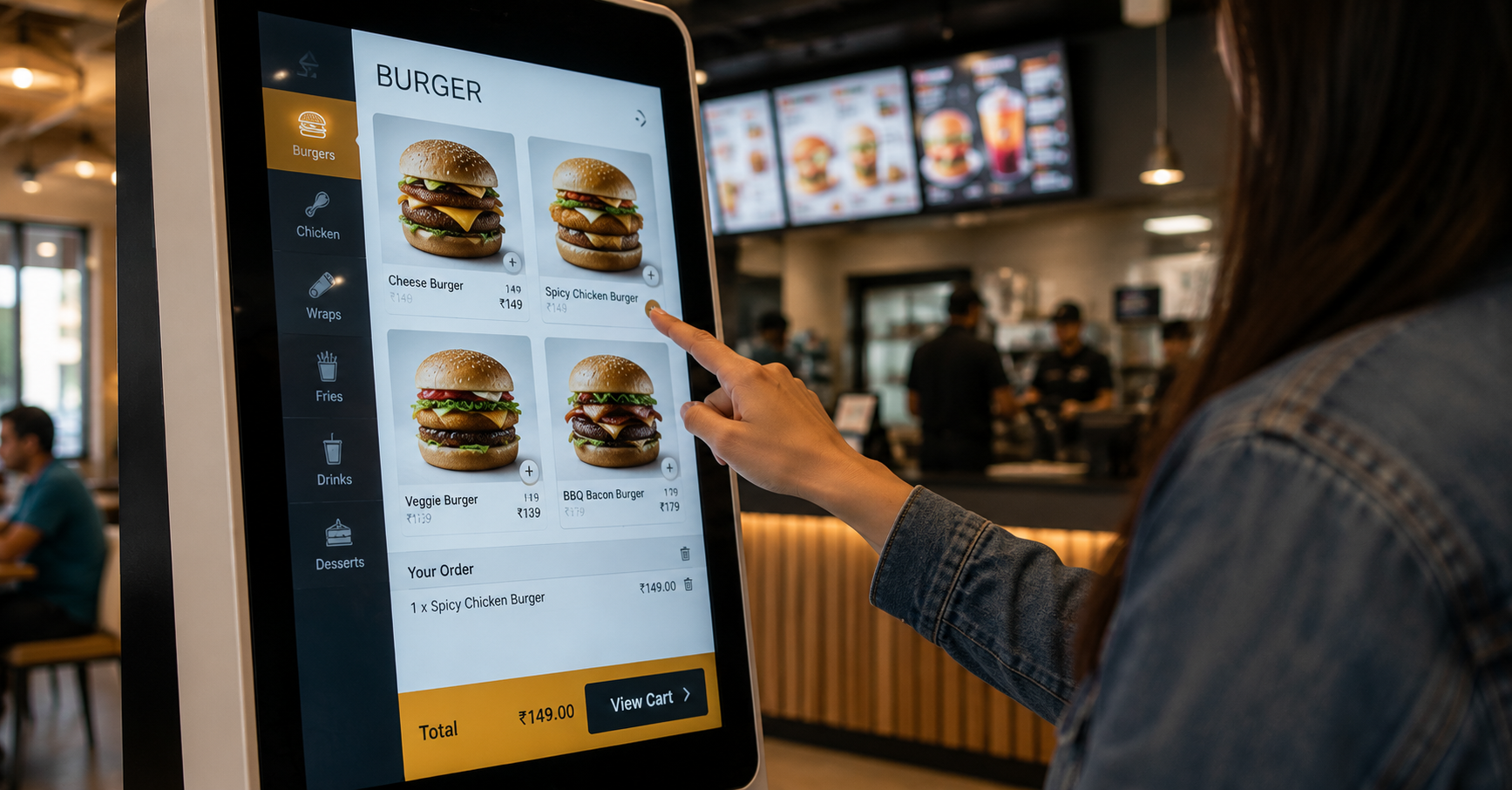
5. Counter-Top Displays
What they are: Compact screens, typically 10 to 21 inches, positioned on service counters, checkout desks, or consultation tables.
Where they work best: At billing counters, service desks, pharmacy consultation points, any location where the customer is stationary and in close proximity for an extended moment. The last opportunity for upsell or cross-sell before the transaction completes.
Strengths: High dwell time at close range, the customer is not walking past, they’re standing and waiting. Ideal for upsell prompts, loyalty programme communication, new product introductions, and service information. Low hardware cost relative to impact in the right placement.
Limitations: Small format limits visual impact. Not appropriate for communication that needs to reach customers at distance. Content needs to be simple and readable at close range, fine text and detailed imagery don’t work at this scale.
Best for: QSR billing counters, pharmacy service desks, beauty retail consultation areas, electronics repair and service counters.
6. LED Cubes
What they are: Multi-sided display structures, typically four faces, suspended or standing in open space, visible from 360 degrees.
Where they work best: Large-format retail atriums, multi-level shopping centres where the audience is distributed across floors and directions, brand activation zones within stores, flagship store centrepieces.
Strengths: Visible from any direction, no suboptimal viewing position. Commands space rather than occupying wall space. Creates a landmark within a retail environment that can be seen from a distance.
Limitations: Requires ceiling rigging or significant floor footprint. Premium hardware and installation cost. Content needs to be designed specifically for a multi-face, 360-degree format, standard flat-screen creative doesn’t transfer. Not appropriate for tight retail spaces.
Best for: Shopping centre atriums, large-format flagship stores, brand activation environments, premium retail launches.
How to Choose: A Decision Framework
Rather than starting with the display format and working backward to a justification, start with the customer journey and work forward to the format.
Map where customers are, and what they need at each point. A customer entering the store has different needs from one standing at a product shelf, waiting at a billing counter, or browsing a window from outside. Each of these moments has a different optimal display format.
Ask what job the display is doing. Attracting foot traffic from outside? Creating brand environment inside? Educating customers at the shelf? Driving upsell at the counter? Each job has a format best suited to it.
Match the content strategy to the format before specifying hardware. A display that requires high-frequency content updates needs to be connected to a CMS that your team can actually manage. A format that demands custom creative needs a content production plan, not just a hardware budget.
Account for the full cost, not just the hardware. CMS subscription, content production, installation, annual maintenance, and support SLAs are all part of the real cost of a retail display deployment. A cheaper screen with a weak CMS and slow support will cost more over three years than a well-specified deployment with a capable platform.
The Combination That Works for Most Indian Retail Operators
For a mid-format Indian retail brand running multiple outlets, the combination that tends to deliver the best return across the network is:
- Digital standees at the entrance and near campaign-relevant product zones, for flexibility and campaign responsiveness
- Counter-top displays at billing points, for upsell and loyalty communication
- Lift-and-learn displays in relevant product categories, for conversion support at the point of decision
- Video wall or large-format screen in flagship or lead outlets, for brand environment and campaign storytelling
Each format does a specific job. Together, they cover the full customer journey from outside the store to the point of purchase without requiring the investment in transparent LED or LED cubes that makes sense only for specific flagship or brand experience contexts.
If you’re working out which display formats make sense for your retail stores whether you’re starting from scratch or reviewing an existing deployment, we’d be glad to walk through what a practical, budget-appropriate combination looks like for your specific context.
Get in touch: contact@techworksworld.com | +91-99109 65918 | techworksworld.com