Digital Display Solutions vs. Traditional Signage: Which Is More Cost-Effective?
This is the question most operators ask at the beginning of a digital signage evaluation, and it rarely gets a straight answer. Vendors selling digital displays will tell you digital always wins. Print suppliers will find reasons the comparison doesn’t hold. Neither perspective is particularly useful.
The honest answer is: over a three-year horizon, digital display solutions are more cost-effective than traditional signage in most commercial contexts but the margin of advantage depends heavily on how frequently content changes, how many locations are involved, and whether the digital deployment is managed well enough to actually use its advantages.
This post breaks down the comparison across the dimensions that actually matter for a procurement decision.
What “Traditional Signage” Actually Costs
The sticker price of traditional signage, a printed flex board, a backlit poster frame, a static lightbox, is typically lower than digital on day one. This is the number that anchors most initial comparisons, and it’s the least useful number in the analysis.
The real cost of traditional signage across a three-year operational period includes:
Production costs for each update. Every time content changes, a price revision, a new product launch, a promotional campaign, a seasonal offer, the creative needs to be designed, approved, produced, and printed. For a retail or QSR brand making six to eight content changes per year across ten outlets, this is a significant and recurring cost that compounds with every additional location.
Logistics and installation. Printed materials need to reach each outlet. In a multi-city network, this means courier costs, installation team time, and the coordination overhead of ensuring the right materials reach the right location at the right time. This cost is invisible in most budgets because it sits in operations rather than marketing, but it’s real.
Downtime between decision and execution. From the moment a content update is decided to the moment it’s live at every outlet, traditional signage has a lag measured in days or weeks, design time, print production, shipping, installation. During that window, the previous content is showing something that may no longer be accurate or relevant. For QSR operators whose pricing changes with GST revisions or input costs, this lag is an operational liability.
Waste from outdated material. Printed signage that’s replaced before the end of its intended life, because a promotion ended early, a product was discontinued, or a campaign was revised, is pure waste. In large networks this accumulates to a meaningful cost.
Compliance and accuracy risk. A price that’s wrong on a printed menu board, a promotional offer that has expired, a product that’s been discontinued still being advertised, each of these carries reputational and sometimes regulatory risk. Traditional signage creates this risk structurally, because there’s always a lag between the world changing and the signage catching up.
What Digital Display Solutions Actually Cost
Digital has a higher upfront cost. This is not disputable, and any comparison that tries to minimise it is being dishonest. A commercial-grade digital display screen, mounting hardware, media player, CMS connection costs more than a printed flex board of the same size.
The full digital cost picture across three years includes:
Hardware. The screen, media player, enclosure (if required), and mounting hardware. For commercial deployments, expect commercial-grade screens rated for extended daily operation, not consumer televisions. The cost varies significantly by screen size, brightness specification, and whether the deployment requires weatherproofing or industrial-grade housings.
Installation. Electrical work, mounting, network connectivity, initial CMS configuration. Higher than traditional signage installation in most cases.
CMS subscription. Most commercial content management platforms charge a monthly or annual fee per screen. This varies by platform tier, Lite-tier platforms for simpler single-outlet use cost less than Pro-tier platforms with advanced scheduling, multi-outlet management, and integration capabilities.
Content updates. For digital, content updates are primarily a design and production cost, the distribution cost is effectively zero. A file uploaded to a CMS reaches every connected screen simultaneously, regardless of how many outlets or how geographically distributed they are.
Maintenance and support. Annual maintenance contracts cover preventive servicing and reactive response. For a well-specified commercial installation, major hardware failures within a reasonable service life are uncommon, but the contract cost is a real line item.
The Break-Even Analysis
For most commercial deployments, the break-even point, where the total cost of digital equals the total cost of traditional over the same period, falls somewhere between 18 months and 30 months, depending on:
Content update frequency. The more frequently content changes, the faster digital pays back. A deployment with six or more content updates per year across multiple outlets typically breaks even well within two years. A deployment where content changes once a year may take longer to justify the digital premium.
Number of locations. The cost of printing and distributing updated content to traditional signage scales linearly with locations, twice the outlets, roughly twice the print and logistics cost. Digital distribution cost is essentially flat regardless of network size. The more outlets in the network, the faster digital reaches break-even.
Content production efficiency. Operators who invest in template-based digital content, where a standard layout is updated with new copy and imagery rather than rebuilt from scratch each campaign, reduce the production cost of digital updates significantly. Operators who treat every digital content change as a full creative production project lose much of the cost advantage.
Hardware lifespan. Commercial-grade displays are typically rated for 50,000 to 70,000 hours of operation, equivalent to 8 to 12 years of standard operating hours. The hardware cost is therefore spread over a significantly longer useful life than most three-year TCO models assume.
Where Traditional Signage Still Makes Sense
A balanced comparison acknowledges where traditional signage is genuinely the better choice.
Single-location, low-change environments. A small owner-operated business where the menu or offering changes once a year, with one location and no ambition to expand, may not reach break-even on a digital investment within a reasonable payback period. The flexibility benefit of digital is worth less when flexibility isn’t needed.
Regulatory or aesthetic contexts where digital isn’t permitted. Heritage zones, planning-restricted areas, and some premium retail environments have restrictions on illuminated or electronic displays. Traditional signage isn’t always a choice, sometimes it’s a constraint.
Very short-term or one-off installations. A pop-up event running for two days, a temporary promotional installation for a weekend, or a single-use wayfinding solution for an event are contexts where the economics of renting or producing printed signage outperform a digital deployment every time.
Outdoor environments without appropriate infrastructure. Outdoor digital signage has specific requirements, weatherproofing, brightness, power and connectivity infrastructure, that make it significantly more expensive than an outdoor print installation. In locations without existing electrical infrastructure, the cost of providing power to a digital display can eliminate the economic case entirely.
The Question That Reframes the Comparison
Comparing digital to traditional on cost alone misses the more significant question: what does traditional signage cost you in revenue opportunities foregone?
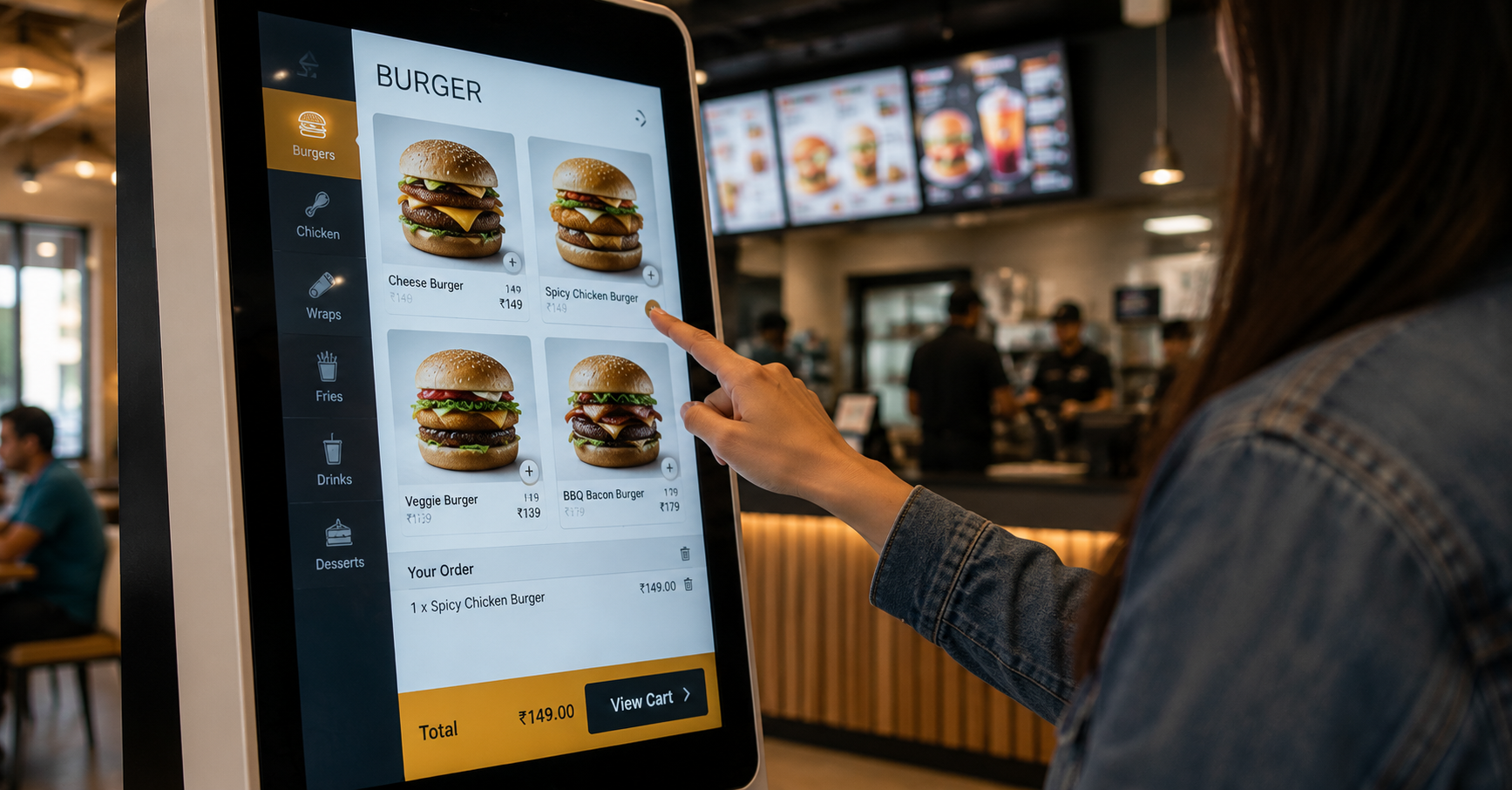
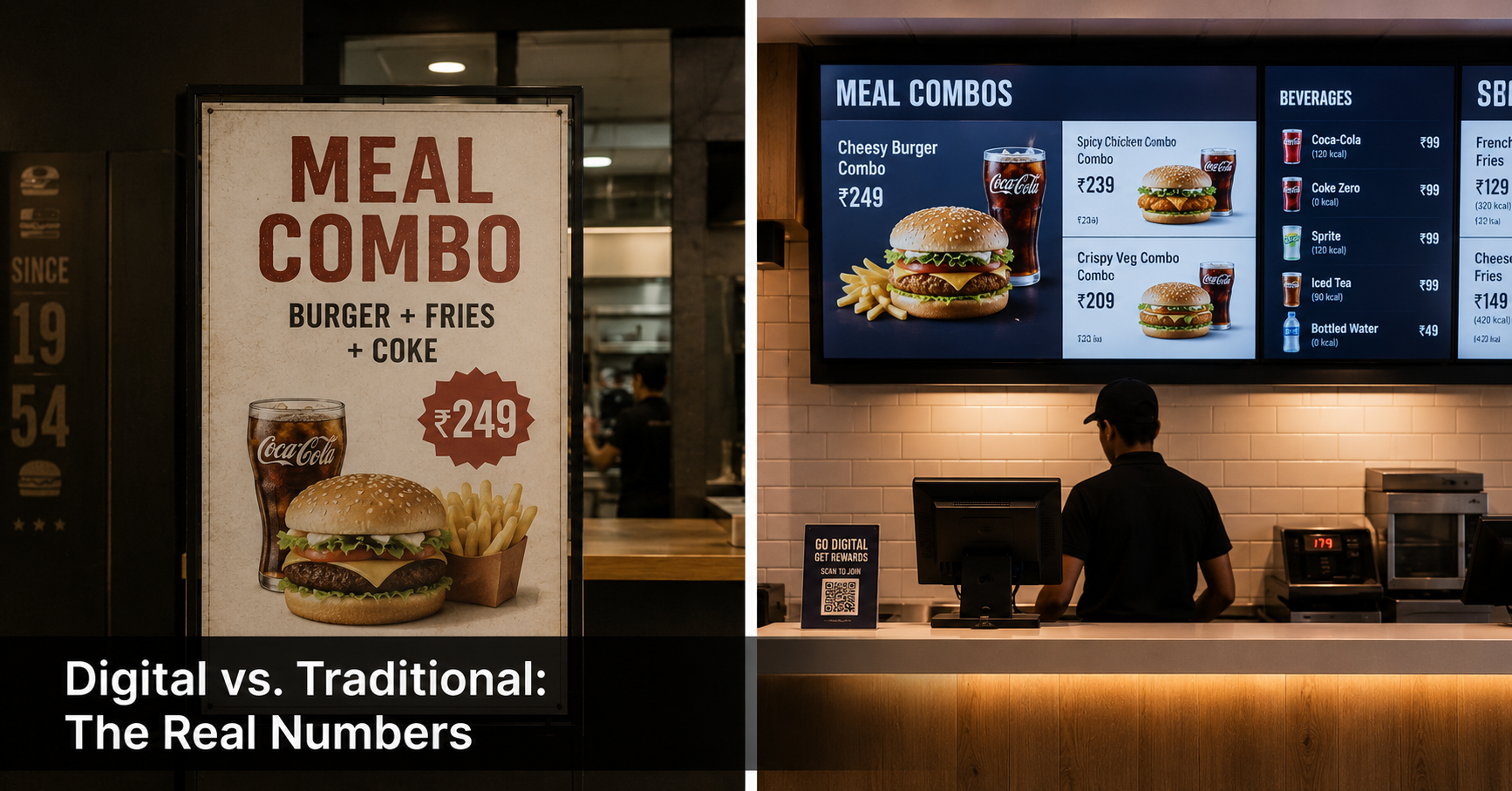
A digital menu board that can run a lunchtime promotion, spotlight a high-margin item during peak hours, and suppress a sold-out product in real time isn’t just cheaper than reprinting a menu board four times a year. It’s doing things a printed board can never do, and those capabilities have a revenue value that doesn’t appear in any cost comparison.
The same logic applies to retail: a digital standee that can be repositioned to follow a seasonal campaign, updated overnight when a product launches, and refreshed weekly to stay relevant isn’t just competing with a static poster on cost. It’s competing on capability, and on that dimension, the comparison isn’t close.
The Summary View
| Factor | Traditional Signage | Digital Display |
|---|---|---|
| Upfront cost | Lower | Higher |
| Update cost per change | High (print + logistics) | Low (CMS upload) |
| Update speed | Days to weeks | Minutes to hours |
| Multi-location consistency | Variable | Centrally controlled |
| Content flexibility | Fixed until reprinted | Real-time adjustable |
| 3-year TCO (multi-location, frequent updates) | Higher | Lower |
| Revenue capability | Static | Dynamic |
For most Indian commercial operators running more than one location and updating content more than four times per year, digital display solutions are more cost-effective than traditional signage over a three-year horizon, not in spite of the higher upfront cost, but in total.
If you’d like to work through the specific numbers for your context, outlets, update frequency, content types, we’d be glad to build out a comparison that reflects your actual deployment, not a generic model.
Get in touch: contact@techworksworld.com | +91-99109 65918 | techworksworld.com