
Beyond the Lobby: What Video Walls Are Actually For in Corporate Environments
Walk into most corporate headquarters built in the last five years and you’ll find a video wall in the lobby. Usually large, usually impressive on day one, and usually — within a year — running a looping brand film that nobody in the building has watched twice.
This is the most common failure mode for enterprise video wall investments: treating them as a single decorative gesture rather than an ongoing communication asset. And it’s a shame, because when planned correctly, a video wall is one of the most versatile tools a corporate environment can deploy — well beyond the lobby, and well beyond branding.
The Lobby Is the Easy Part
A reception area video wall makes sense as a first step. It signals investment, sets a tone for visitors, and reinforces brand identity at the first point of contact. Most enterprises get this part right.
Where the opportunity gets missed is everywhere else in the building. The same display technology and content infrastructure that powers a lobby wall can extend into spaces that actually shape how employees and visitors experience the organisation day to day — and these are the deployments that tend to deliver far more sustained value.
Where Video Walls Earn Their Place Beyond the Lobby
Town Hall and All-Hands Spaces
Large gatherings — quarterly town halls, leadership addresses, company-wide announcements — benefit enormously from a display format that can be seen clearly from the back of a large room. A modular video wall, sized to the space, eliminates the compromises of projector setups: no ambient light washout, no need to dim the room, no awkward shadow when someone walks in front of the projection.
For organisations running hybrid town halls — some employees in the room, others joining remotely — the video wall can also serve double duty: displaying the in-person presenter alongside a live feed of remote questions or a shared screen, without the visual quality dropping the way it does on a single projected screen.
Operations and Command Centres
For organisations with logistics, security, network operations, or customer support functions, a video wall in a command centre setting serves an entirely functional purpose: displaying multiple data streams simultaneously — dashboards, live feeds, system status, regional maps — in a format that supports rapid situational awareness.
This is a fundamentally different use case from a branding wall. The content here is operational, often real-time, and the display needs to support high-resolution data visualisation without the seams or bezels that interrupt readability. The value isn’t aesthetic; it’s functional, and it’s measured in faster response times and better-coordinated teams.
Cafeteria and Common Areas
Common spaces are where a video wall can do quiet, continuous work that a lobby display can’t — because people spend actual time there, not just passing through. Rotating content showing internal announcements, recognition of employee milestones, safety updates, or even just curated information feeds gives the space a sense of life and relevance that a static poster board never achieves.
The key difference from the lobby is dwell time. Content here can be longer-form and more detailed, because people are sitting with it for fifteen or twenty minutes, not walking past it for five seconds.
Meeting and Collaboration Spaces
For larger conference rooms and collaboration hubs, video walls support a different kind of value: enabling multiple simultaneous content sources — a presentation on one section, a video call on another, a shared whiteboard on a third — without forcing everything onto a single screen and constant window-switching.
This use case is growing as hybrid work makes high-quality, flexible meeting room technology a genuine productivity factor rather than a nice-to-have.
Recruitment and Visitor Experience
Beyond the first-impression lobby moment, video walls along visitor routes — near interview rooms, training centres, or innovation labs — can be used to tell a more detailed story: company history, culture, ongoing projects, employee testimonials. For organisations competing hard for talent, this kind of considered, well-produced environment communicates something that a generic poster wall cannot.
What Makes a Video Wall Deployment Actually Work
Content Strategy Comes Before Hardware
The single biggest determinant of whether a corporate video wall delivers ongoing value is whether there’s a real plan for what plays on it — and who’s responsible for keeping that current.
This means assigning clear ownership (usually internal communications, sometimes HR or facilities), establishing an update cadence, and building a content library that doesn’t run dry after the first quarter. A video wall without a content plan becomes the brand-film-on-loop problem within months.
Modular, Seamless Display Technology
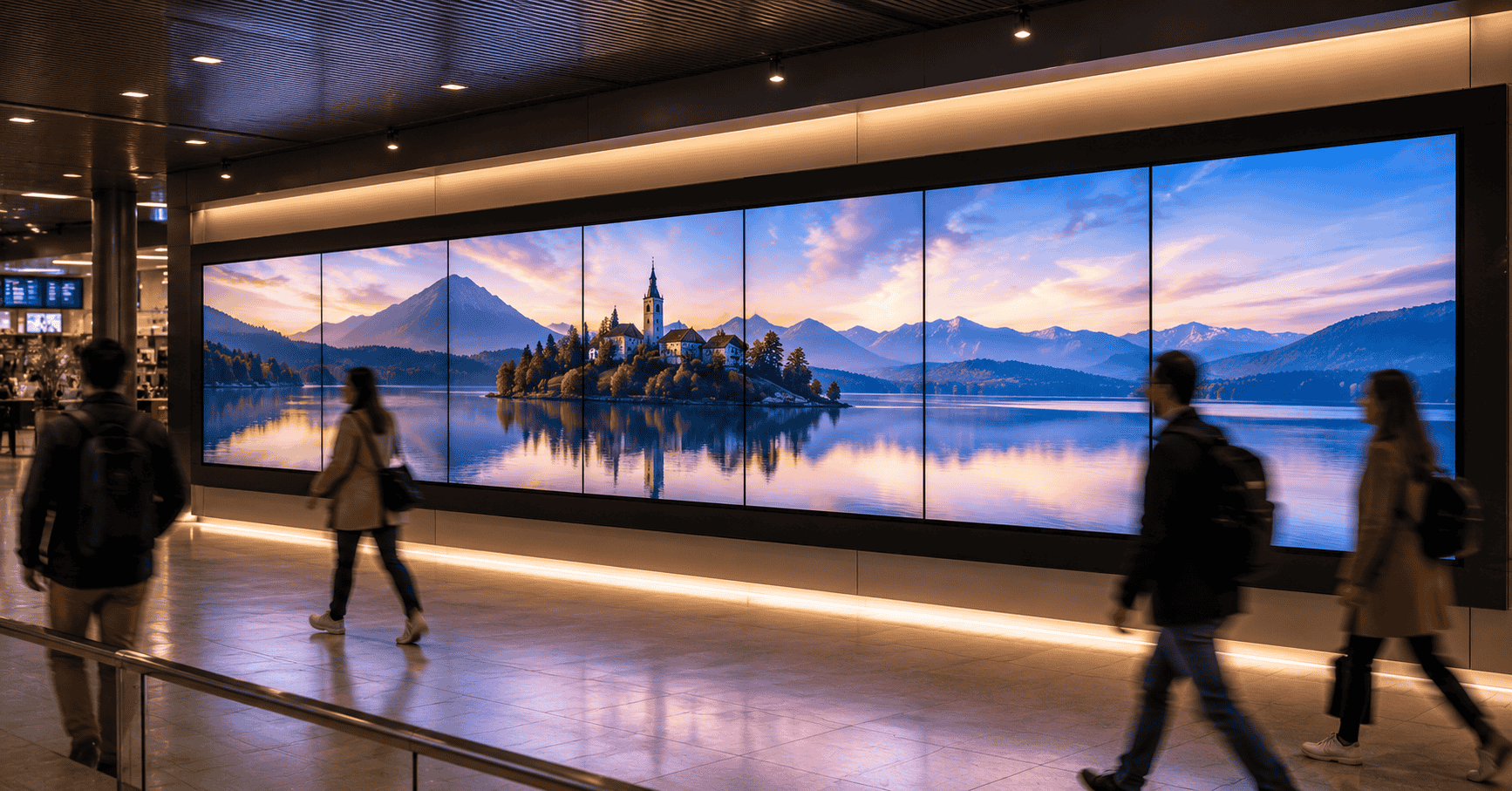
For corporate environments — where the video wall is often viewed up close, in well-lit rooms, by people walking past or sitting nearby — bezel width and seam visibility matter more than in some other contexts. Fine-pitch LED or narrow-bezel LCD video wall configurations deliver the kind of seamless image that doesn’t look like several screens stitched together.
Centralised, Flexible Content Management
Different spaces in the same building often need different content: the lobby runs brand content, the cafeteria runs internal announcements, the command centre runs live dashboards. A CMS capable of managing distinct content streams across multiple video walls — from a single platform, with appropriate access control per space — is what makes a multi-zone deployment manageable rather than chaotic.
Integration with Existing Systems
For operational deployments particularly, the video wall needs to pull data from existing systems — building management platforms, security feeds, business intelligence dashboards — rather than requiring manual content creation for information that already exists elsewhere in the organisation.
The Planning Question Worth Asking Early
Before specifying a video wall for a corporate environment, the most useful question isn’t “how big should it be?” It’s: “What is this wall going to be doing in eighteen months, and who is responsible for making sure it still is?”
A lobby wall with no owner and no content plan degrades into wallpaper within a year, regardless of how impressive the hardware was at installation. A wall with a clear purpose, an assigned content owner, and a manageable update workflow continues delivering value long after the initial impression has worn off.
If you’re planning a video wall deployment for a corporate or enterprise environment — whether it’s a single lobby installation or a multi-zone rollout across town hall, operations, and common spaces — we’d be glad to walk through what the right configuration looks like for your space.
Get in touch: contact@techworksworld.com | +91-99109 65918 | techworksworld.com