The Factory Floor Is a Communication Problem — Digital Displays Are Part of the Answer
Manufacturing facilities are, in one sense, extraordinary feats of coordinated communication. Hundreds of people, across multiple shifts, in loud and demanding environments, need to share the same understanding of targets, status, safety protocols, and exceptions — reliably, in real time, every day.
And yet the communication infrastructure in most Indian manufacturing facilities hasn’t kept pace with the operational sophistication around it. Production targets are written on whiteboards. Safety notices are laminated A4 sheets taped near doorways. Shift handover happens through a notebook passed between supervisors. KPI dashboards exist — in a spreadsheet, on a supervisor’s laptop, accessible to almost nobody on the floor who could actually act on the information.
The gap between the data that exists and the data that reaches the right person at the right moment is where manufacturing efficiency quietly leaks. Digital displays on the factory floor are not a technology upgrade for its own sake — they’re a communication infrastructure investment aimed squarely at closing that gap.
What the Factory Floor Actually Needs to Know
Before specifying any display technology for a manufacturing environment, it’s worth being precise about what information needs to move, to whom, and how frequently.
Most factory floor communication falls into a few categories:
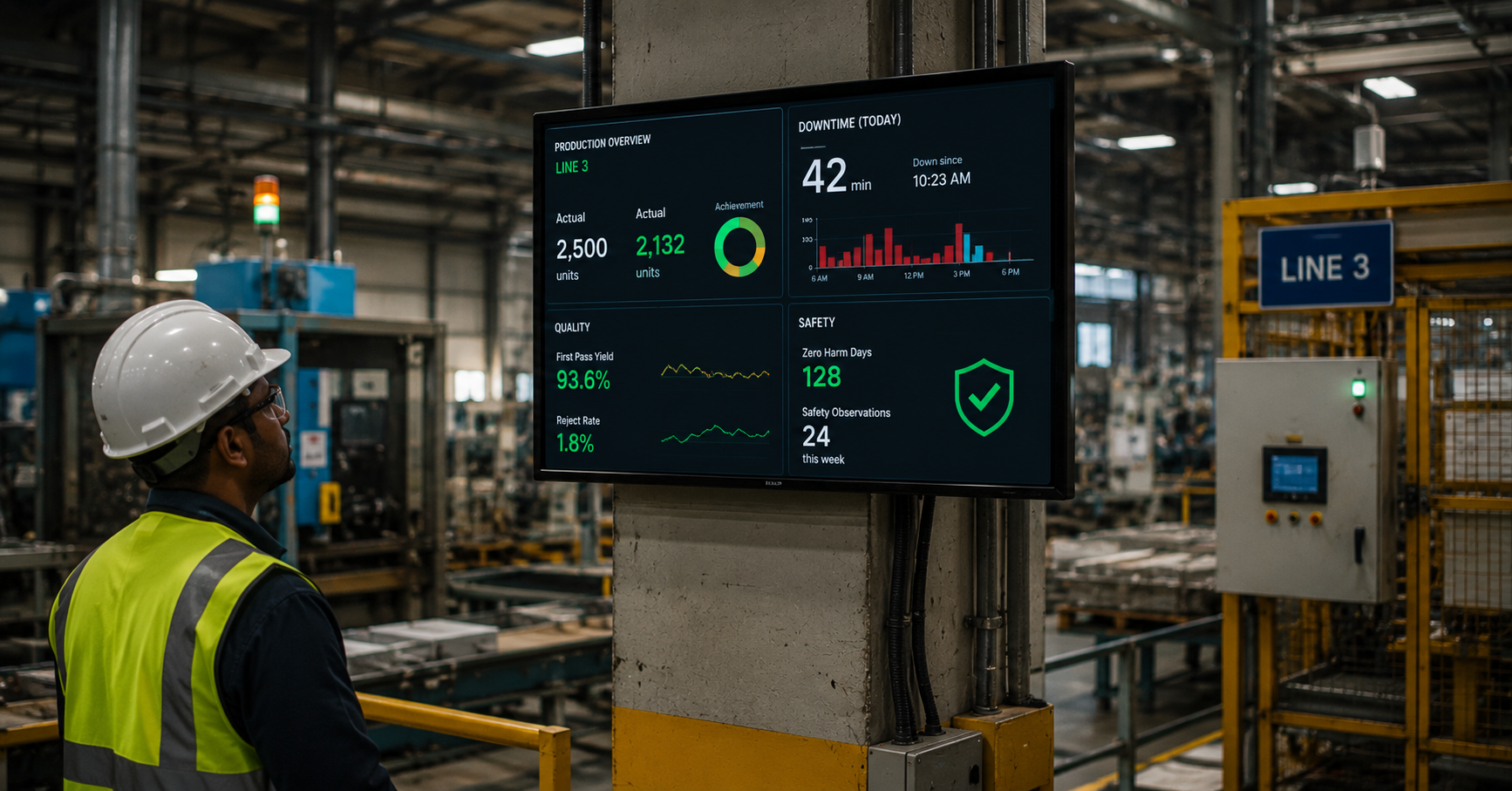
Production status. Current output vs. target, line speed, units completed this shift, projected end-of-shift attainment. This is the information that drives hour-by-hour operational decisions, and it’s the information that most supervisors and team leaders currently have to go looking for rather than having it visible.
Quality and defect tracking. Defect rates by line or station, rejection counts, quality alerts. In facilities with zero-defect or Six Sigma programmes, this data is being collected — but often only reviewed in daily or weekly meetings, long after the window to intervene has closed.
Safety information. Days without incident, current hazard alerts, PPE reminders, emergency protocols. Safety communication in most facilities cycles through the same laminated sheets for months, becoming invisible through familiarity. Dynamic digital displays can rotate safety messages, highlight current alerts, and ensure safety communication remains visible rather than wallpaper.
Downtime and maintenance. Machine status, planned maintenance windows, unplanned downtime events. For facilities tracking OEE (Overall Equipment Effectiveness), downtime visibility in real time allows faster response from maintenance teams rather than waiting for a supervisor to make a call.
Shift and HR information. Attendance, upcoming shift changes, training schedules, company announcements. Information that currently reaches workers through notice boards, WhatsApp groups, or word of mouth.
The Environment Challenge
Factory floors are not office environments, and display technology needs to be specified accordingly.
Dust and particulates are a constant factor in most manufacturing environments — metal shavings, textile fibres, chemical dust, food processing residue depending on the facility type. Screens need to be either enclosed in appropriate housings or rated to an ingress protection standard that matches the environment.
Noise means that audio-based communication is rarely viable. Displays need to communicate visually, with high-contrast content and large text that reads clearly at a distance, often over the heads of workers at stations.
Ambient light varies dramatically — some facilities are brightly lit, others have areas of shadow or variable natural light. Screen brightness needs to be adequate for the installation location, and content needs to be legible in both conditions.
Mounting constraints differ from commercial environments. Screens may need to be suspended from ceiling structures, mounted on floor-standing poles in the middle of a production area, or integrated into existing line infrastructure. Flexibility of mounting solutions matters more on a factory floor than in a retail or office environment.
Shift patterns mean the display system runs continuously — often 24 hours across three shifts. Hardware rated for continuous operation and content that updates automatically without human intervention between shifts are non-negotiable.
The Integration Case: Connecting Displays to What Already Exists
The most valuable factory floor display deployments are not those showing static targets and safety slogans. They’re the ones connected to the facility’s existing data systems — pulling live production figures from MES or ERP platforms, surfacing quality data from QMS systems, updating maintenance status from CMMS platforms.
When a display shows live OEE rather than yesterday’s report, it becomes an operational tool. When it shows current defect rate against a target threshold, it triggers action rather than retrospective analysis. When it shows real-time attendance against planned headcount, supervisors can respond before a shortfall affects output.
This integration doesn’t require a complex bespoke development project. Most modern manufacturing data platforms expose APIs or simple data feeds that a capable CMS can consume and display. The key requirement is a display management system that supports data-driven content — showing live figures pulled from a source rather than manually entered text.
Zoning the Factory Floor
Not every area of a manufacturing facility needs the same type of display or the same content. A zoned approach — matching display format and content to the specific communication need of each area — delivers far better outcomes than a uniform installation across the facility.
Production lines: Large-format displays showing line-specific KPIs — current output, target, defect rate, downtime status. Updated in real time, visible from the line without workers leaving their stations.
Entrance and muster points: Shift briefing information, safety highlights, attendance, daily production goals. The moment workers enter the facility or gather for shift start is the highest-leverage communication window of the day.
Supervisor stations: More detailed dashboards — cross-line comparison, escalation alerts, maintenance queue. Smaller screens showing higher-density information for the people who need to act on it.
Common areas and canteens: Company announcements, recognition, HR information, safety campaign content. Dwell time in these areas is higher, so content can be more detailed and varied.
Maintenance and engineering areas: Equipment status, work orders, parts availability. Functional information for a specific team.
The Shift That Makes This Work
The single biggest obstacle to effective factory floor communication isn’t the technology. It’s the discipline of treating communication on the floor as a managed function — with ownership, update cadence, and accountability — rather than something that happens informally.
A display that shows yesterday’s production targets, or a safety message that’s been on the screen for four months, does not improve on the laminated A4 sheet it replaced. The investment in hardware and connectivity only pays off when the content stays current, relevant, and acted upon.
This means assigning clear ownership of what appears on each zone of displays. It means integrating live data feeds where possible, so the update burden is minimal. And it means building content review into existing operational rhythms — the daily production meeting, the weekly safety review — rather than treating it as a separate task.
If you’re looking at digital display infrastructure for a manufacturing facility — whether a pilot on a single production line or a facility-wide rollout across zones — we’d be glad to walk through what a practical deployment looks like.
Get in touch: contact@techworksworld.com | +91-99109 65918 | techworksworld.com