See-Through and Say More: What Transparent LED Displays Are Actually Capable Of
The first time most people see a transparent LED display in action, the reaction is the same: they walk closer to understand what they’re looking at. A screen that shows dynamic content while remaining visually permeable — you can see through it and see on it simultaneously — doesn’t match the mental model most people carry for what a display is supposed to be.
That reaction is useful, commercially. But it’s also a distraction from the more substantive question: what does this format actually do well, and where does it belong?
Transparent LED is not a novelty technology looking for a use case. It’s a specific display format with a defined set of applications where it outperforms every alternative — and a set of applications where it’s the wrong choice entirely. Understanding the difference is what separates a deployment that earns its investment from one that looks impressive for a month and then raises questions at the next budget review.
How It Works
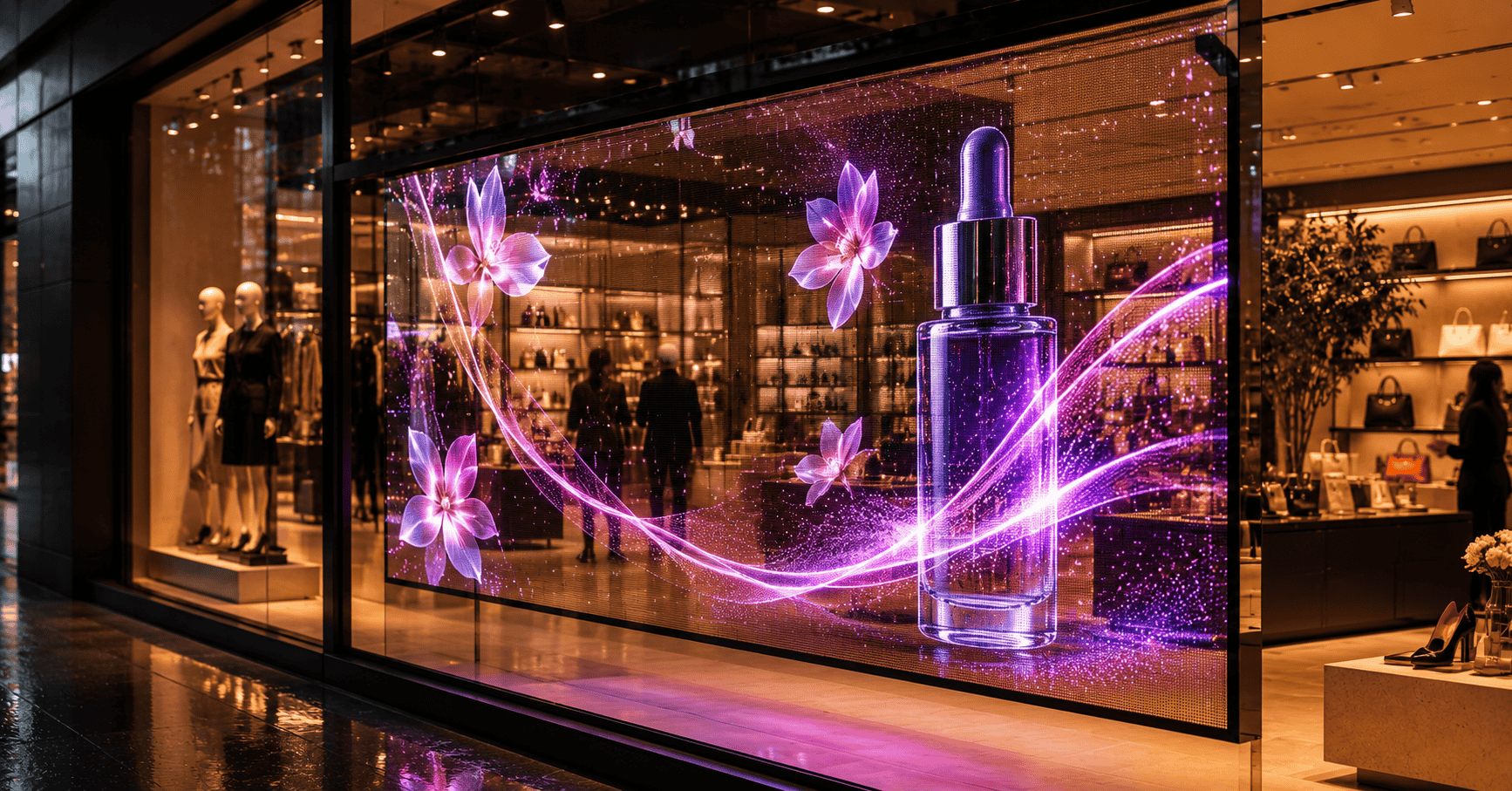
A transparent LED display is constructed from a grid of LED modules mounted on a lightweight frame — typically aluminium — with significant open space between the LED clusters. The open space is what creates the transparency. Light passes through the gaps, allowing the viewer to see what’s behind the display while the LEDs render content on the visible surface.
Transparency rates typically range from 70% to 95%, depending on the pixel pitch and module design. Higher transparency means more light passes through and the background remains clearly visible; lower transparency allows higher resolution content but reduces the see-through effect.
The display is typically mounted directly in glass — a shopfront window, a glass partition, a glazed façade — or suspended as a free-standing installation in an open space. In either configuration, the defining characteristic is what it preserves: the visual connection between the space behind the display and the viewer in front of it.
This is the fundamental distinction from a conventional opaque display. A standard screen placed in a window blocks the window. A transparent LED placed in the same window keeps the window — and adds a live content layer over it.
Where Transparent LED Belongs
Retail Storefronts
The most established application, and the one where the format delivers most consistently. A street-facing glass shopfront is prime real estate — it’s the moment before a customer decides whether to enter. Dynamic content on the glass can communicate a campaign, a new arrival, a promotion, or simply the brand’s visual identity, without sacrificing the sight lines that make a retail window work.
For premium retail — fashion, jewellery, beauty, consumer electronics — the window is a brand statement. Transparent LED preserves the curation of what’s inside the store (products, fixtures, lighting) while adding a layer of communication that changes as often as needed. A static window installation requires a visual merchandising team and lead time every time it changes. A transparent LED window can be updated from a CMS in minutes.
The practical consideration for retail is ambient light. Transparent LED in a shopfront needs sufficient brightness to be legible in direct sunlight — a specification question that needs to be answered honestly at the point of procurement, not discovered after installation.
Premium Brand Environments and Flagship Stores
Beyond the window, transparent LED has a role inside premium brand environments — dividing spaces without closing them, creating visual backdrops that preserve a sense of openness, or serving as the centrepiece of a brand installation that needs to be visually arresting without feeling heavy or opaque.
For flagship stores, showrooms, and brand experience centres where the spatial design is itself part of the brand identity, transparent LED integrates into the architecture in a way that a conventional screen cannot. It occupies space without dominating it.
Corporate and Institutional Glazed Spaces
Glass-walled boardrooms, reception areas with glazed partitions, and institutional buildings with significant glazed façades represent a growing application area. A transparent LED panel on a glass boardroom wall can display content during presentations and remain visually open when not in use — without the permanent visual weight of an opaque screen or projection surface mounted in the same location.
For buildings with branded glazed façades — corporate headquarters, hotels, cultural institutions — exterior transparent LED installations create a live communication surface that doesn’t compromise the building’s architectural intent or daylighting.
Exhibition and Event Environments
For temporary installations — trade stands, brand activations, product launches — transparent LED offers a visual drama that conventional displays don’t. A suspended transparent LED panel in an open exhibition space creates presence without enclosure. The see-through quality reads as confidence: the brand has nothing to hide, and the display itself is part of the statement.
Where It Doesn’t Belong
Transparent LED is not the right answer for every high-visibility display need, and understanding the constraints is as important as understanding the capabilities.
Where image resolution is the primary requirement. Transparent LED at typical pitch specifications delivers adequate image quality for large-format, mid-to-far viewing distances. For close-up viewing of detailed content — fine text, high-resolution product photography, data dashboards — conventional LED or LCD displays offer significantly better image fidelity.
Where the background is visually busy or unattractive. The format depends on the background being part of the visual composition. A transparent LED display mounted in front of a cluttered storage area, an unattractive structural element, or a space with inconsistent lighting will look worse than an opaque display in the same location. The see-through quality is an asset only when what’s behind the display is worth seeing.
Where brightness conditions aren’t matched to specification. Transparent LED in direct, intense sunlight requires high-brightness specification. Underspecified brightness renders the display effectively invisible in daylight — a common and avoidable failure. Any outdoor or semi-outdoor installation requires an honest assessment of sunlight conditions by time of day and season before specifying the hardware.
Where budget is the primary constraint. Transparent LED commands a premium over conventional LED of equivalent size. For applications where the transparency is not central to the effect — a display that happens to be near a window but doesn’t need to be on it — a conventional display is the right choice.
Content for Transparent LED: A Different Design Brief
Content created for a conventional opaque display doesn’t translate directly to transparent LED. The background is always present and always in play — which means the content needs to be designed with the specific background in mind, not as if the screen were a blank canvas.
The most effective transparent LED content works with the background rather than against it. Motion and animation read better than static images. Bold graphic elements — typography, simple shapes, strong colour fields — work better than photographic content or fine detail. Dark or semi-transparent sections of the content allow the background to show through; dense, bright sections create emphasis.
This is a creative brief that most digital content teams haven’t worked on before, and it’s worth setting up correctly at the start of a deployment rather than discovering mid-campaign that the existing content library doesn’t translate.
The Specification Questions Worth Asking
Before specifying a transparent LED installation:
- What is the ambient light level at the installation location, by time of day and season? What brightness specification does the display need to remain legible?
- What is the primary viewing distance? This determines the appropriate pixel pitch.
- What is behind the display, and is that background an asset or a liability for the installation?
- Who is creating content, and do they have experience designing for transparent LED specifically?
- What is the mounting situation — directly into glass, suspended, or frame-mounted — and what structural constraints does the installation location present?
These questions don’t have universal answers. But they need to be answered specifically for each installation before hardware is specified, not after.
If you’re evaluating transparent LED for a retail storefront, corporate environment, or brand installation — and want to understand whether the format is right for your specific application — we’d be glad to walk through it.
Get in touch: contact@techworksworld.com | +91-99109 65918 | techworksworld.com