How Techworks Compares to Other Digital Display Solution Providers
This is a question we get asked directly, and it deserves a direct answer, one that doesn’t read like a brochure and doesn’t pretend competitors don’t exist. The digital display market in India has grown significantly over the past decade. There are now a range of providers operating across the spectrum: multinational hardware brands, pure-play software vendors, system integrators who add signage to a broader AV portfolio, and specialist signage companies like Techworks. Each category has genuine strengths and genuine limitations.
What follows is an honest assessment of how those categories differ, where Techworks sits within that landscape, and what the distinctions actually mean for a buyer making a procurement decision.
The Landscape: Who’s Selling Digital Signage in India
Multinational Hardware Brands
Global display manufacturers, companies whose primary business is the screen itself, are present in the Indian market through channel partners and distributors. Their hardware is typically high quality, well-supported by international specifications, and backed by global warranty programmes.
The limitation of buying through a hardware brand’s channel is that the screen is the product. The content management system is usually a third-party platform the channel partner has selected or recommended, not something the hardware brand has developed or owns. After-sales support for the software layer, the installation, and the ongoing deployment is the channel partner’s responsibility, and channel partners vary significantly in their depth of signage expertise and their capacity to support deployed networks over time.
For buyers who want hardware from a globally recognised brand name and are comfortable managing the software and support relationships separately, this is a workable model. For buyers who want integrated accountability, one provider responsible for hardware, software, installation, and ongoing support, it typically isn’t.
Pure-Play Software Vendors
Some providers in the Indian market lead with a CMS platform and work with the buyer to source hardware separately or through a hardware supply partnership. The advantage of this model is that the software is often more sophisticated than what a hardware-bundled CMS provides, these companies have invested their product development resources in the platform rather than the screen.
The limitation is that hardware sourcing, installation quality, and on-ground support are often thinner than with a full-service deployment provider. A sophisticated CMS connected to poorly installed hardware, or managed by a support team with limited on-site capability, underperforms what either component could deliver with the right partner for the other.
AV System Integrators with Signage as One Practice
Many audiovisual integration companies include digital signage as part of a broader offering that may span conference room AV, boardroom technology, and event production. These companies often have strong installation teams and broad technical capability.
The limitation is that signage is frequently not their primary focus. A company whose core business is boardroom AV may not have the specialised understanding of content management at scale, the India-specific deployment experience across diverse verticals, or the depth of CMS knowledge that a dedicated signage provider brings.
Specialist Digital Signage Providers
This is the category Techworks sits in. Companies whose primary focus is digital display and kiosk technology, hardware, software, installation, and ongoing managed support, as a unified offering.
The advantage of this model is integration and accountability. One provider is responsible for every layer of the deployment: specifying hardware appropriate for the environment, deploying a CMS suited to the operational model, executing the installation, and supporting the network over time. When something goes wrong, and in any long-running deployment, something eventually does, there is one point of contact, one team accountable for resolution.
The limitation, across the category, is variability. Not all specialist providers have the same depth of experience, the same product range, or the same service infrastructure. Within the category, the differences between providers are meaningful.
Where Techworks Specifically Differs
Deployment Scale and Track Record
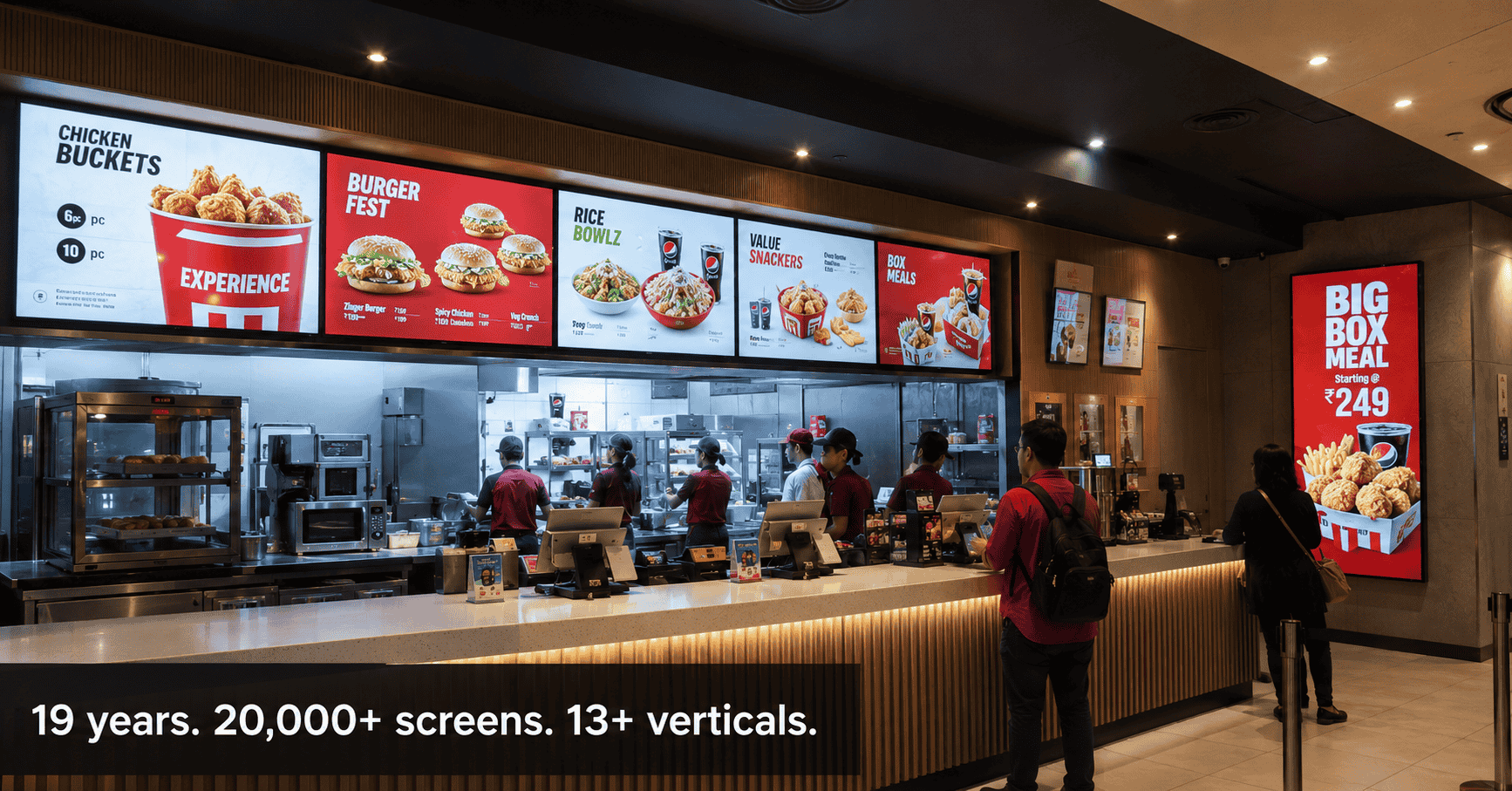
Nineteen years in the Indian market and more than 20,000 live screens across 13-plus verticals is not a number that can be claimed by most providers operating in this space. It represents a specific kind of knowledge, what works in Indian operating conditions, what fails, how to specify for the environments that exist rather than the environments that are assumed.
The practical value of this track record is in the details: knowing that a screen specified for an air-conditioned European retail environment behaves differently on Indian power supply, that connectivity in Tier 2 city franchise outlets requires a different offline resilience architecture than Mumbai mall deployments, that heat and humidity specifications matter differently in Chennai than in Delhi. This is not knowledge that comes from a product catalogue. It comes from having deployed, managed, and serviced networks across India for nearly two decades.
Owned Product Portfolio
Techworks operates with an owned product portfolio across display hardware and software, Vustr DMB, Vustr Glass, Vustr SOK, xtravu DSS, xtravu eSENSE, and KOD, rather than reselling a combination of third-party hardware and third-party software under a services wrapper.
The significance of this for buyers is product accountability and integration depth. When the same organisation has developed the CMS and deployed the hardware, the integration between them is tighter, the support accountability is cleaner, and the roadmap for both is coordinated. A provider assembling best-of-breed third-party components can deliver a capable system, but the accountability for how those components work together is distributed.
Vertical Depth
Techworks has active deployments across QSR, retail, corporate, hospitality, manufacturing, healthcare, education, and heritage/cultural verticals. This breadth produces a different kind of specification capability than a provider whose experience is concentrated in one or two sectors.
A QSR operator evaluating a self-order kiosk deployment benefits from a partner who has also deployed in retail and understands how self-service interfaces need to be designed for different audience profiles. A heritage institution benefits from a partner who has worked in both cultural and commercial environments and can navigate the constraints of both. Cross-vertical experience produces a more calibrated specification capability than deep specialisation in a single sector.
Service Infrastructure
Techworks operates its own service infrastructure rather than relying entirely on third-party service partners for reactive support. For buyers in geographies where third-party service coverage is thin, this matters. A screen that goes dark at a QSR outlet during lunch service needs a committed response time, not a promise that a third-party technician will be dispatched when one is available.
Where Competitors Have Genuine Advantages
An honest comparison acknowledges where other providers do things better.
Global hardware brands have stronger international warranty and certification depth. For buyers where global procurement standards, specific certifications, or international warranty terms are non-negotiable requirements, a multinational hardware brand’s channel may be better positioned than a domestic specialist.
Some pure-play CMS vendors have more advanced software feature sets. The most sophisticated CMS platforms in the global signage market are built by companies whose entire product investment goes into the software layer. For deployments where advanced programmatic content, AI-driven audience analytics, or deep third-party API integration are day-one requirements, a specialist software vendor may be worth evaluating alongside a full-service provider.
Large AV integrators may have broader technical team capacity for very large concurrent rollouts. A deployment requiring simultaneous installation across 200 outlets in a compressed timeline may benefit from the bench strength of a large AV integration company, depending on geographic coverage.
The Questions That Actually Differentiate Providers
Rather than asking vendors to compare themselves, which produces predictably self-serving answers, buyers are better served by asking questions that reveal actual capability:
- Show me five deployments you’ve completed in my vertical, in Indian operating conditions, at the scale I’m planning. Can I speak to the operators?
- Who owns the CMS, did you build it or resell it? What does that mean for how updates and support work?
- What is your service response time commitment for a screen going dark in a live operational environment, and what is the escalation process if that commitment isn’t met?
- How many outlets can your installation team service concurrently, and in which geographies?
- What does a deployment look like eighteen months after installation, not at launch?
A provider who answers these questions specifically, with references available and honest acknowledgment of limitations, is describing a real capability. A provider who answers in generalities is describing an aspiration.
We’re happy to answer any of these questions directly, including the ones about where we’re not the right fit.
Get in touch: contact@techworksworld.com | +91-99109 65918 | techworksworld.com