
How Retail Brands Are Using Digital Displays at the Point of Decision
The most important moment in retail isn’t when a customer walks through the door. It’s the three to five seconds when they’re standing in front of a product, deciding whether to pick it up.
Everything before that moment — the advertising, the in-store navigation, the window display — has done its job. It got them there. What happens in those few seconds at the shelf, the counter, or the fixture is where the purchase is won or lost.
This is the point of decision. And it’s where India’s more progressive retail brands are now deploying digital displays — not as decoration, but as a working part of the sales architecture.
The Problem with Traditional In-Store Communication
Walk into most Indian retail outlets and the in-store communication story is familiar: a mix of printed shelf talkers, hanging danglers, backlit poster frames, and brand-supplied standees that may or may not be current. Some of it was designed six months ago. Some of it is promoting a product the store no longer stocks.
The core issue is not creativity — most of this print material is well-designed. The issue is timing and relevance. By the time a printed piece reaches a store, goes through the fixture team, and gets placed at the shelf, the promotional window may have already passed. And once it’s up, it stays up — whether the offer is live or not, whether the season has changed or not.
Retail moves faster than print can follow. Digital displays at the point of decision close that gap.
Where Displays Are Making the Biggest Difference
At the Shelf: Lift-and-Learn
Lift-and-learn is one of the most effective applications of interactive retail display technology. A sensor — typically RFID or weight-based — detects when a customer picks up a product, and triggers content on a nearby screen: a product demonstration, an ingredient breakdown, a comparison with a related SKU, or a usage video.
The customer gets information at the exact moment they want it, without needing to scan a QR code or ask a staff member. The brand controls what story gets told — and tells it every time, consistently, across every outlet.
For categories where purchase confidence is low — skincare, wellness, consumer electronics accessories, premium food — this matters significantly. A well-informed customer converts at a higher rate than one left to read a label and guess.
At the Fixture: Digital Standees and Counter Displays
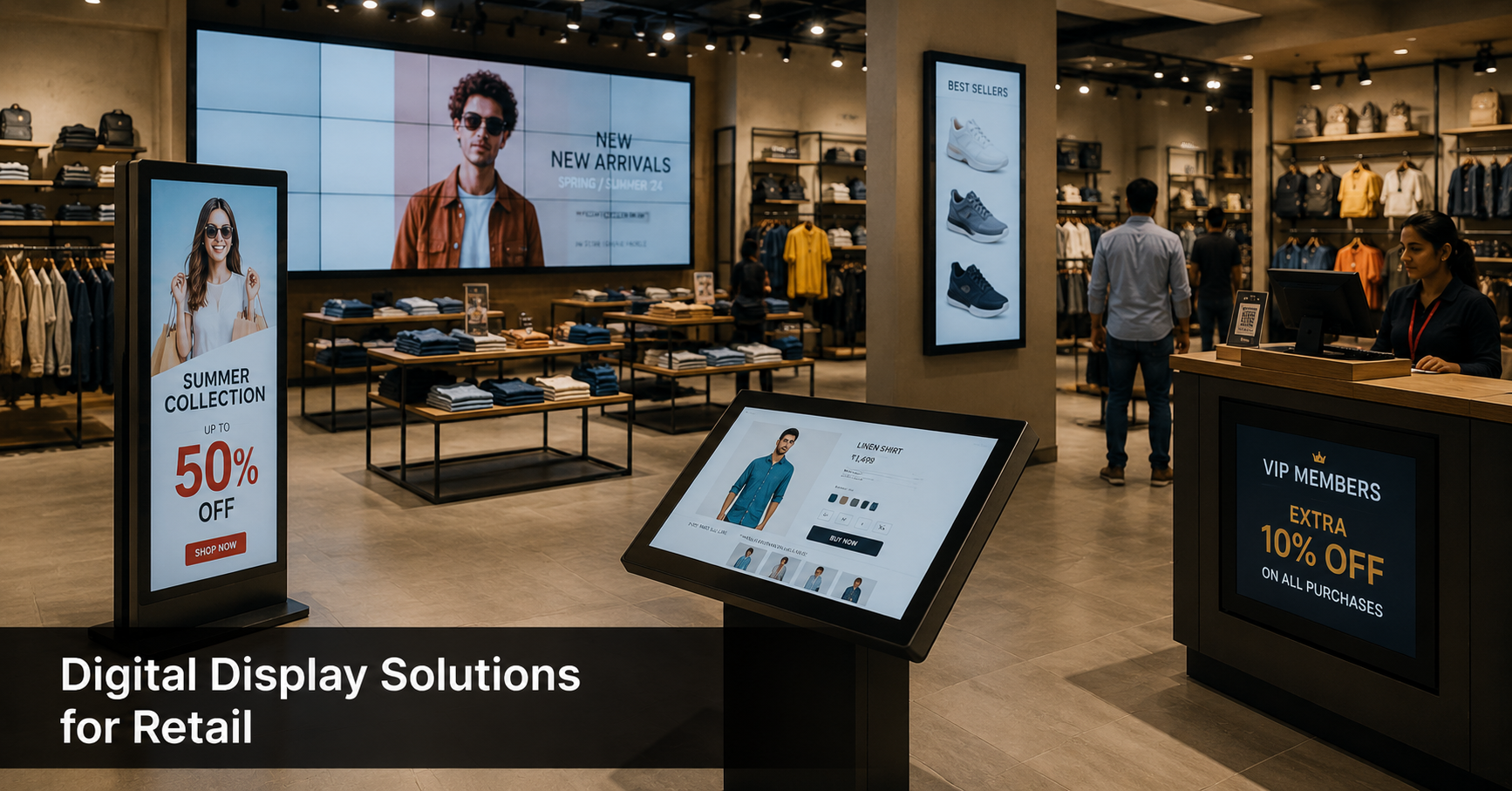
Free-standing digital displays placed adjacent to a product range serve a different function — they create visual presence and draw attention from a distance. In a crowded retail environment where every fixture is competing for eyeball time, motion on a screen will almost always win over a static poster.
For brand launches, seasonal campaigns, and new product introductions, a digital standee in the right location can deliver the kind of impact that would previously require a full window display or gondola end treatment. And unlike a window display, it can be updated overnight when the campaign changes.
Counter-top digital screens — placed at billing counters or service desks — serve a dual purpose: brand communication while the customer is waiting, and last-minute upsell or cross-sell at the point of payment.
At the Window: Transparent LED
For brands with street-facing storefronts, transparent LED displays represent a fundamentally different kind of retail media. The display sits in the window glass itself — allowing the physical store merchandise to remain visible while overlaying dynamic content on top of it.
The effect, done well, stops foot traffic. The store window becomes a live canvas that changes by campaign, by time of day, or by season — without blocking the sight lines that make a retail window work in the first place.
This is not a mass-market solution. It’s appropriate for premium brand environments, flagship stores, and concept retail where the storefront experience is part of the brand statement. But in those contexts, it delivers a visual impact that no other format can match.
At Scale: Video Walls
For large-format retail environments — multi-brand stores, large-format electronics outlets, premium showrooms — video walls create brand environments rather than just brand messages. A well-executed video wall in the right location doesn’t just show content; it defines the character of the space.
The practical consideration for multi-outlet retail operations is content control. A video wall that requires an agency to update content every time a campaign changes is an expensive, slow asset. One connected to a cloud-based CMS that allows the retail team to push updates directly — changing campaigns, rotating products, responding to stock availability — is a commercial tool.
The Operational Shift: From Campaigns to Always-On
The traditional retail marketing model runs on campaign cycles — a new creative every six to eight weeks, briefed to an agency, produced, dispatched, installed. This model was built around print, and it has real limitations in a world where retail conditions change faster than that.
Digital displays enable a different operating model: always-on communication that can be updated in hours, not weeks. A new product lands in store — it’s on the display the same day. A competitor drops a price — the messaging can respond by the evening. Stock of a SKU runs low — it stops being promoted immediately.
This isn’t about replacing campaigns. It’s about having the ability to move at the speed that modern retail actually demands.
What Indian Retail Brands Are Getting Right — and Where the Gap Remains
The brands that are extracting the most value from in-store digital displays in India share a few characteristics:
They treat the screen as a sales tool, not a branding exercise. The content is specific, action-oriented, and tied to purchase behaviour — not just a looping brand film.
They connect display management to their merchandising calendar. Updates are planned in advance, not reactive. The display knows what’s happening in the store before the customer arrives.
They have centralised content control. For multi-outlet operations, a single team manages what goes live across all locations. There is no version drift, no outdated campaigns, no store manager printing a poster because the digital content hasn’t arrived yet.
The gap, for most Indian retailers still in early stages of digital display adoption, is usually not the hardware. It’s the content operations model — the workflow, the team ownership, and the CMS capability that makes a display genuinely manageable at scale.
The Right Display for the Right Moment
No single display format does everything. The most effective retail digital display strategies use a layered approach:
| Location | Format | Primary Function |
|---|---|---|
| Window / storefront | Transparent LED or high-brightness display | Attract foot traffic, brand statement |
| Entrance / main aisle | Digital standee or large-format screen | Campaign communication, new arrivals |
| Category fixture / shelf | Lift-and-learn or shelf-edge screen | Product education, purchase confidence |
| Billing counter | Counter-top display | Upsell, cross-sell, loyalty |
| Flagship / showroom | Video wall | Brand environment, immersive storytelling |
The question for any retail operator is not “should we have digital displays?” It’s “which moments in our customer’s in-store journey are we currently leaving to chance — and what would happen to conversion if we didn’t?”
If you’re working through a retail display strategy for your stores — whether a single flagship or a multi-outlet network — we’d be happy to walk through what a deployment looks like in practice.
Get in touch: contact@techworksworld.com | +91-99109 65918 | techworksworld.com